Data from 2016 pegs it as the hottest year since recording began way back in 1880. Carbon dioxide levels continue to sit at historical highs, and last year the UN Intergovernmental Panel on Climate Change warned that humanity has just 12 years to limit warming to 1.5 C.
Reducing emissions is the gold standard, but it’s not the only way to go about solving the problem. There has been much research into the field of carbon sequestration — the practice of capturing atmospheric carbon and locking it away. Often times, this consists of grand plans of pumping old oil wells and aquifers full of captured CO2, but there’s another method of carbon capture that’s as old as nature itself.
As is taught in most primary school science courses, the trees around us are responsible for capturing carbon dioxide, in the process releasing breathable oxygen. The carbon becomes part of the biomass of the tree, no longer out in the atmosphere trapping heat on our precious Earth. It follows that planting more trees could help manage carbon levels and stave off global temperature rises. But just how many trees are we talking? The figure recently floated was 1,000,000,000,000 trees, which boggles the mind and has us wondering what it would take to succeed in such an ambitious program.
Can Trees Really Help?
Research has been done into the possibilities of global reforestation as a tactic to address climate change. Bastin, et al determined that there was capacity for a further 0.9 billion hectares of forest cover on Earth. It would take around 1 trillion trees to do so.
Here’s the real eye-opener: these trees could store 205 gigatonnes of carbon dioxide, which would account for 2/3rds of the carbon dioxide humans have added to the atmosphere since the start of the Industrial Revolution. There’s plenty of benefits to planting trees on this scale. So just what would it take to plant a trillion trees?
A Trillion Is A Big Number
It’s a number that few of us come up against in day to day life. A trillion is equal to a thousand billion, or 1,000,000,000,000. Planting that many trees promises to require an unholy effort. The idea of getting the job done by hand — it’s about 130 trees per living person — boggles the mind, but there are other approaches that exist.
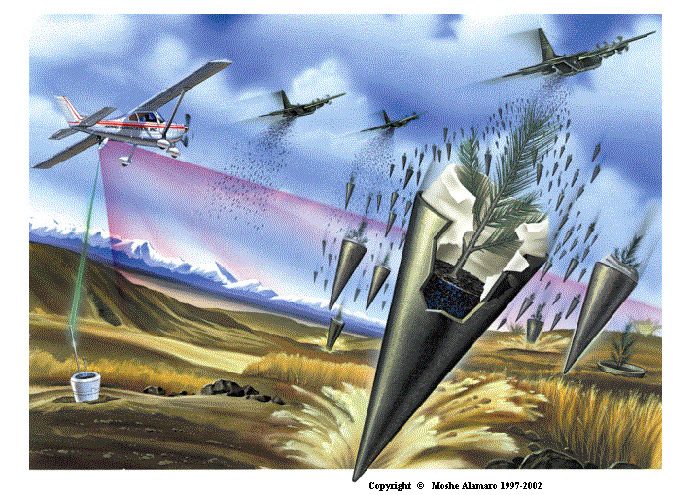
One of the most promising ideas is that of aerial reforestation. The now seemingly defunct Aerial Forestation Inc. proposed a plan back in the late 1990s aiming to repurpose military aircraft fitted out to drop landmines. They would instead be reconfigured to drop specially designed cones, containing a sapling as well as fertilizer and moisture absorbent materials. The cones would bury themselves in the soil upon impact, biodegrading to allow the root system of the tree to develop.
Estimates suggest that a C-130 aircraft could deliver 125,000 trees per sortie, and up to 900,000 trees in a day. This is huge number of trees to be putting into the soil, but a trillion is still an enormous milestone to reach. Some back of the envelope calculations highlight the hurdles to be overcome to reach that number.

There are 2500 C-130 transport aircraft in the world. Assuming most of them are busy most of the time doing their existing jobs, a conservative estimate suggests that perhaps 250 aircraft could be dedicated to reforestation duties full time. It’s unlikely that every single day will be suitable for dropping trees, especially in the drier summer months. Making a ballpark estimation for weather and logistical concerns, we can say that perhaps 50% of the days of the year will be available for tree drops. With 250 aircraft working 182 days a year dropping 900,000 trees each day, that adds up to a touch over 40 billion trees a year. At this rate, it would take 25 years to get to 1 trillion trees. Not exactly a quick solution.
Unfortunately, there are more real world factors that get in the way of this becoming a reality. Simply keeping 250 aircraft flying such a rigorous schedule would require an effort nearing the level of the Berlin Airlift. Additionally, producing the saplings for delivery is no small task either, and would require huge swathes of land to be devoted to the production of both the saplings themselves as well as the cone casings for aerial delivery. For all this effort, the job would still take 25 years to complete!
Throwing more aircraft at the problem would speed delivery, but only further increase the logistical difficulties of producing enough tree-ammo to drop on prospective forest locations. And we haven’t even touched on the fact that it’s far from likely that 100% of dropped trees will successfully grow.
There are further issues with trees as a carbon bank, too. Most of us who have heard of forests have also heard of forest fires — and trees only act as a carbon sink when they’re not burning. In areas where outbreaks of fire are common, grasslands can be a safer choice. This is due to the fact that several plant varieties store the majority of their carbon in their root systems, which don’t tend to burn. Any major project would have to take into account the best plant choice for the given region, balancing what can be grown in the local ecosystem with fire risks and the most efficient species for carbon storage.
It’s likely within the realms of possibility that this could be achieved. However, it would require a level of commitment similar to the total war doctrine seen in World War II, where countries geared their entire economic output towards ensuring their own survival. Of course, with the spectre of catastrophic climate change still looming on the horizon, that may be exactly what needs to happen anyway.
Progress is Made One Step at a Time
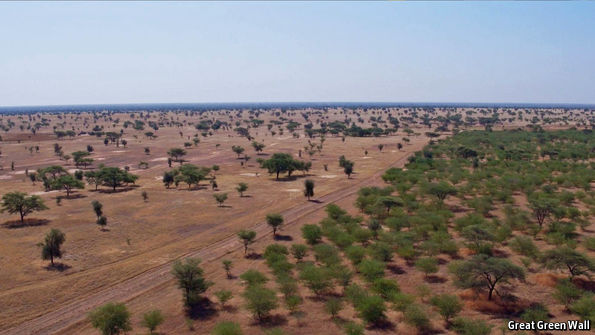
While it’s demonstrably not easy to plant 1 trillion trees, let alone quickly, that doesn’t mean nobody is trying. The Billion Tree Campaign started back in 2006, and planted a billion trees by 2007. After morphing into the Trillion Tree Campaign, it has planted 13.6 billion trees to date, through a variety of methods involving donations and community involvement. Other efforts are also underway – China has undertaken significant reforestation activity, and the Great Green Wall project aims to significantly change the current state of the African landscape.
While it’s unlikely that we’ll see the trillion tree milestone reached anytime soon, all progress towards this goal is beneficial. In combination with emissions reductions and other environmental measure taken, there’s hope that catastrophic climate events can still be staved off with the right actions taken.