Before I got a license and a car, getting to and from high school was an ordeal. The hour-long bus ride was awful, as one would expect when sixty adolescents are crammed together with minimal supervision. Avoiding the realities going on around me was a constant chore, aided by frequent mental excursions. One such wandering led me to the conclusion that we high schoolers were nothing but cargo on a delivery truck designed for people. That was a cheery fact to face at the beginning of a school day.
What’s true for a bus full of students is equally true for every city bus, trolley, subway, or long-haul motorcoach you see. People can be freight just as much as pallets of groceries in a semi or a bunch of smiling boxes and envelopes in a brown panel truck. And the same economic factors that we’ve been insisting will make it far more likely that autonomous vehicles will penetrate the freight delivery market before we see self-driving passenger vehicles are at work with people moving. This time on Automate the Freight: what happens when the freight is people?
Running Scared
There’s a saying in the investment game: the trend is your friend. Investors have a lot of sayings like that, mostly aimed at convincing themselves that they have the slightest clue about what’s going to happen with a given company’s stock, when it’s all pretty much up to chance in the absence of inside information. The trends in investing patterns can still be useful, though, because they tend to point out how people are thinking. That can be a handy tool for investors and non-investors alike.
So it was with interest that I stumbled upon an article about the potential impact of self-driving cars on the airline industry. On the face of it, you’d think that there would be no risk to airlines from cars, especially in the United States. But the article points out that US domestic carriers like Southwest depend on routes that average 757 miles (1218 km) and last about two hours. People gladly pay for these flights, enduring the indignities of modern air travel that begin hours before the flight and potentially end days after landing in the form of jet lag. And they do so precisely because the alternative is worse – to most people, at least; I for one vastly prefer long-distance driving to flying. I’m weird like that.
But fast forward to a future where fully autonomous vehicles are an everyday thing, and battery capacities have increased enough that an electric vehicle can cover the same distance as the average Southwest flight. We’re actually not far from that now – a Tesla once did 670 miles on one charge. Or, forget the batteries and consider an internal-combustion self-driver. Either way, a vehicle plying the roads is obviously not going to beat a jet airliner for speed, but it doesn’t have to because it can drive all through the night. And the passengers, unencumbered by the need to drive, can simply sleep the trip away, to arrive in the morning as if by magic, fresh and relatively unharried, at least compared to their TSA-probed counterparts at the airport.
Not convinced that airline executives should be quaking in their wingtips at a self-driving future? Then take a look at this map:
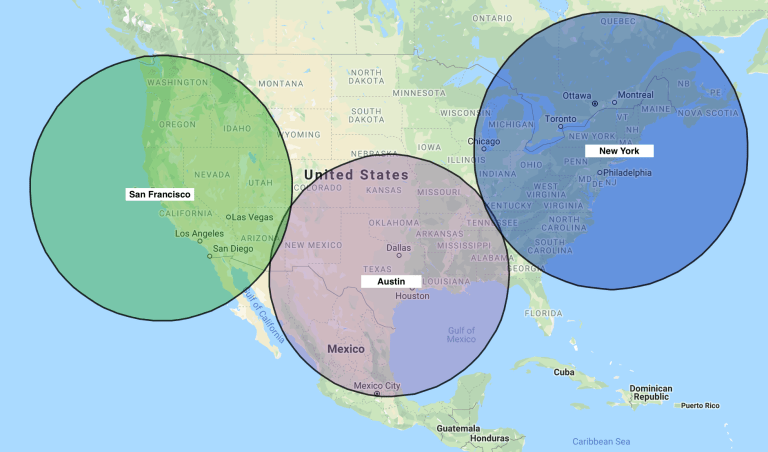
Each circle is about how far one can drive from San Francisco, Austin, or New York overnight – roughly 11-12 hours. Yes, it’s difficult to drive in the ocean, and these are straight-line distances that don’t take the location of highways into account. But still, it shows just how much of the country can be covered with a reasonable overnight drive. And the promise of having slept through it all without having been sealed in an aluminum tube full of unhappy people and their germs might just be a reason for panic in the corporate suites of regional air carriers.
The Night Bus
The idea of sleeping the night away while traveling might sound like it would need to wait for true autonomous vehicles, but it’s actually a service that’s already available. An overnight bus service called Cabin was launched in 2017, offering a premium overnight travel experience that whisked passengers between San Francisco and Los Angeles while they slept. The idea was to use traditional human-piloted motorcoaches outfitted with sleeping compartments falling somewhere between cozy and claustrophobic, depending on your leanings. You’d get on the bus late in the evening, zonk out in your rack, and hop off the bus as fresh as a daisy in the morning.
As anyone who has experienced the marginally maintained roads of nearly every major city in the US can imagine, it didn’t quite pan out. The experience of jolting through the night to the roar of a mighty diesel was less than restful, and Cabin was forced to shut down operations to retool its fleet of sleep coaches. But the fact that they didn’t just fold completely shows there’s still demand for a lower-cost regional transportation option, and that offering an overnight trip is attractive to enough people to make the idea worth investing in.
People Moving on Demand
As for a future, fully autonomous version of Cabin, I’d say that self-driving motorcoaches carrying large numbers of passengers on regional routes are not likely to catch on, at least in the USA, for the same reason that bus lines and passenger rail have never caught on in here: lack of flexibility. Being stuck showing up at a bus depot at a specific time to take the sleepy bus isn’t much different than having to show up at the airport two hours before a 90-minute flight. If a plane offers a choice of departure and arrival times, chances are good that people will choose to fly rather than sleep-drive.
But, imagine smaller self-driving vehicles, perhaps the size of a large van, with four or so bunks and a small comfortable seating area that could be booked for travel on demand. Businesses might jump at the chance to have teams taken safely to meetings overnight, or to use travel time for working. Families might love to have an autonomous van come up the driveway for a pajama-clad trip to Disneyworld. College students could team up for a cheap spring break trip, pool long rides home for the holidays, or just go on a road trip with consequence-free drinking and driving.
All that said, from the point of view of the passengers, where the vehicle is driven by a computer or by a human matters not. All they know is that they’re not driving, and they’re free to nap or read or work while the miles peel away. But to the company providing the service, eliminating the costs associated with hiring large numbers of human drivers is probably a good argument for investing in autonomous vehicles. Providing the freedom of sleeping, working, or partying during the trip would just be a way to add value and attract the customers needed to justify the expense of automating the people-freight.