The basic technology of radio hasn’t changed much since an Italian marquis first blasted telegraph messages across the Atlantic using a souped-up spark plug and a couple of coils of wire. Then as now, receiving radio waves relies on antennas of just the right shape and size to use the energy in the radio waves to induce a current that can be amplified, filtered, and demodulated, and changed into an audio waveform.
That basic equation may be set to change soon, though, as direct receivers made from an exotic phase of matter are developed and commercialized. Atomic radio, which does not rely on the trappings of traditional radio receivers, is poised to open a new window on the RF spectrum, one that is less subject to interference, takes up less space, and has much broader bandwidth than current receiver technologies. And surprisingly, it relies on just a small cloud of gas and a couple of lasers to work.
Quantum Music using Rydberg Atoms
The term atomic radio seems a bit confusing at first. After all, aren’t all radios made from atoms? But in the context of differentiating traditional radio technologies from the newer approach, use of the term atomic makes sense. Atomic radio relies on Rydberg atoms, which are atoms of elements such as cesium and rubidium that have had their outer electrons coaxed into much, much higher quantum states than normal matter, using either laser light at exactly the right wavelength or other electromagnetic methods. The electrons are so far from the nucleus in Rydberg atoms that they are barely held in orbit, the orbits are nearly circular, and the atom approaches macroscopic size.
Because of the highly excited outer electrons, Rydberg atoms have interesting and useful properties. The spacing between electron levels that far out from the nucleus is extremely narrow, making it very easy to perturb electrons and make them change states. If, say, a passing radio wave hits a Rydberg atom, its outer electrons can be nudged to another level. What’s more, Rydberg atoms show the nonlinear optical property of electromagnetically induced transparency, or EIT. That means that a laser tuned to a specific frequency can saturate a gas of Rydberg atoms, rendering them optically transparent in a narrow slice of the spectrum. A second laser tuned to that optical window will shine right through the gas with little loss of intensity.
Atomic radio combines these two properties: a small cell full of excited cesium vapor is rendered transparent with a laser tuned to 852 nm. The cell also has a laser at 510 nm passing through it to a photodiode. When a microwave signal is transmitted through the cell, the vapor’s transparency is reduced proportionally to the strength of the incident radio wave, which results in a signal from the photodiode that can be amplified. This means that unlike conventional radio antennas that operate electromagnetically, atomic radio directly detects radio waves optically.
No Static at All
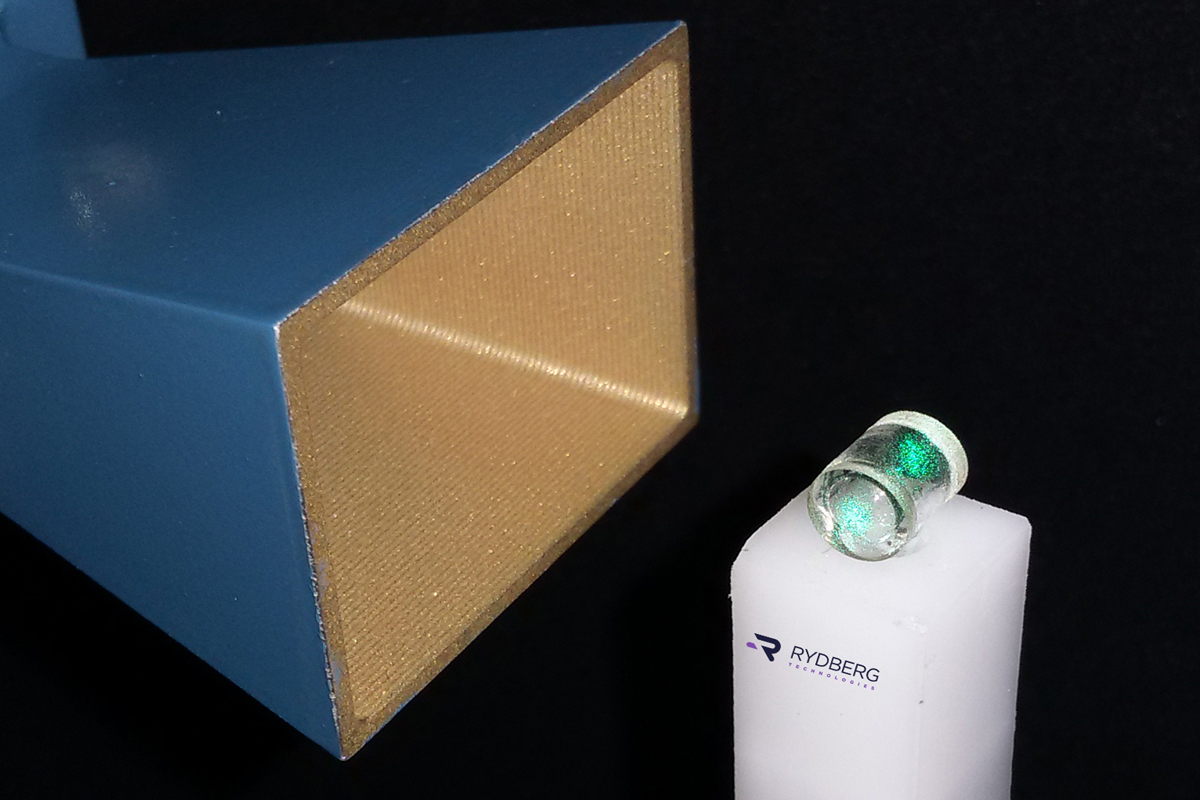
In a way, atomic radio hearkens back to the aforementioned days of spark gap radios. The earliest radio receivers used coherers to detect passing radio waves. Coherers were simple glass tubes filled with iron filings that had metal contacts at each end. Under normal conditions, the iron filings would not be very conductive, owing to insulating oxides creating a high-resistance path through the loosely packed particles. But a passing radio wave would cause the filings to clump together, reducing the resistance through the coherer and causing it to conduct. The radio wave’s passage could be indicated with a bell or a light.
Of course, coherers need a device called a decoherer, which was essentially a solenoid to gently tap the tube and reset the iron filings to a loose, non-conductive state. An atomic radio receiver needs no such resetting, and as recent work by David Anderson, Rachel Sapiro, and Georg Raithel shows, it is capable of receiving modulated signals, both AM and FM, which coherers were not. Still, the analogy is apt.
The simplicity of atomic radio is attractive. There are no tuned circuits, no intermediate amplifiers, no RF mixers, and critically, no antenna in the traditional sense. Radio waves are detected directly based on how they interact optically with the Rydberg atoms. This means that the stages of a traditional radio receiver that are subject to picking up interference are not present in an atomic radio, resulting in a much lower tendency to pick up noise. And because the Rydberg atom vapor is sensitive to a wide range of radio frequencies, an atomic radio is a broadband receiver — the one demonstrated in the above paper had a four-octave range, from the C-band to the Q-band, or 4 GHz to 50 GHz.
Living in Stereo
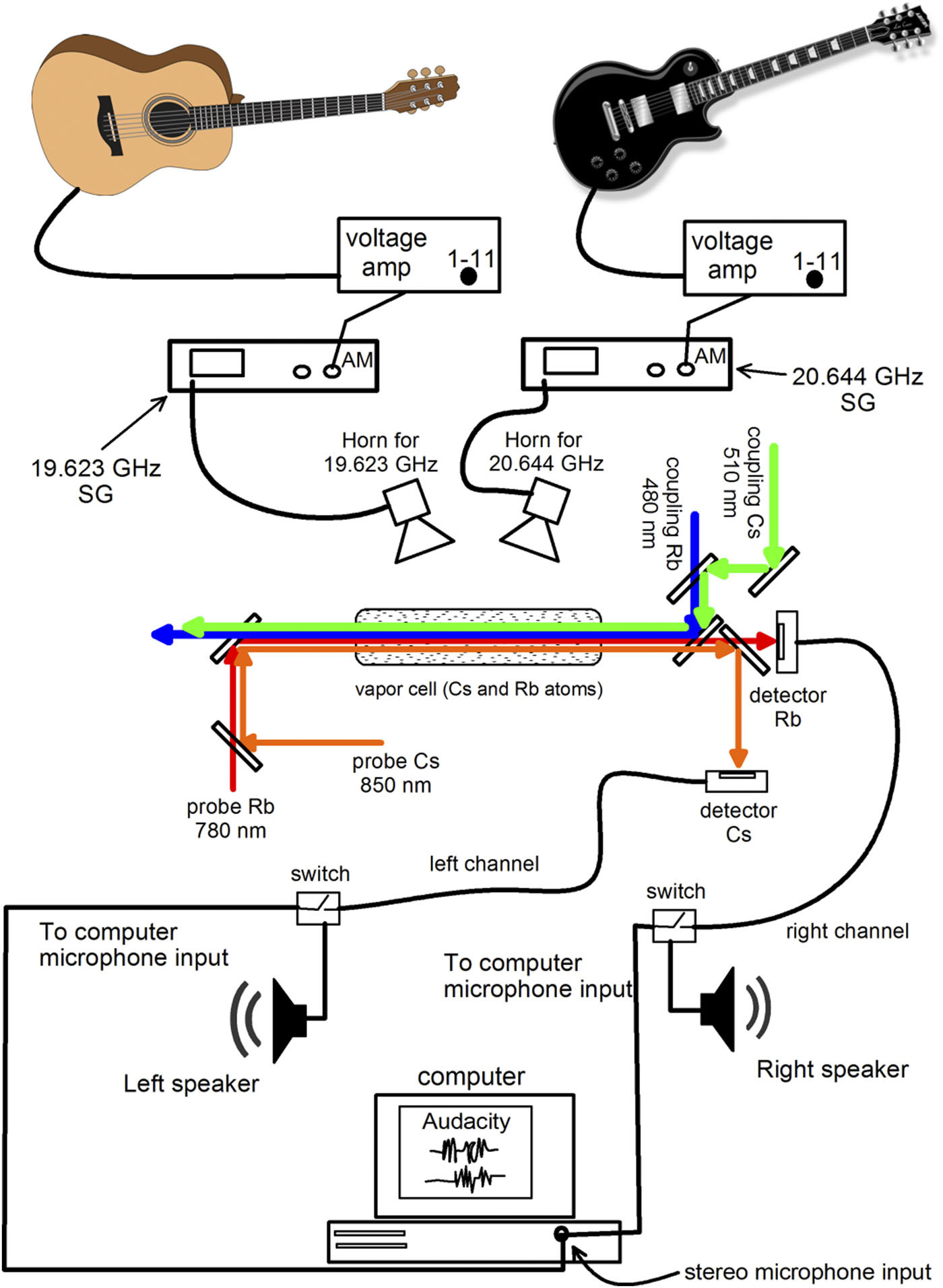
More recently, Christopher Holloway et al at the National Institute of Standards and Technology demonstrated an atomic radio that can receive two signals at once. The vapor cell in this radio contained a mix of cesium and rubidium, and each channel required two lasers — one to saturate each species to transparency, and one to probe for RF. Two guitars were played into audio amps (the authors took pains to note that the amps had gain knobs that go to 11) which were used to modulate two microwave signal generators at different frequencies in the 20 GHz range. The probing lasers were directed through the cell and into two separate photodiodes using optical splitters, resulting in a stereo atomic radio.
Atomic radio is at once both simple and complex — simple in that it bypasses most of the traditional circuitry of radio receivers and detects radio waves directly, but complex because it takes a physics lab full of lasers and optics to make it work. So it’s not likely that rank-and-file hobbyists will be building their own atomic radios anytime soon, and hams won’t be tearing down their half-wave dipole antennas in favor of cesium vapor cells. But atomic radio has a lot of potential, especially in deep-space communications applications, and if it can be miniaturized sufficiently, we just might see another commercialization of quantum theory.