If for some reason I were to acknowledge the inevitability of encroaching middle age and abandon the hardware hacker community for the more sedate world of historical recreation, I know exactly which band of enthusiasts I’d join and what period I would specialise in. Not for me the lure of a stately home in Regency England or the Royal court of Tudor London despite the really cool outfits, instead I would head directly for the 14th century and the reign of King Edward the Third, to play the part of a blacksmith’s wife making nails. It seems apposite to pick the year 1337, doesn’t it.
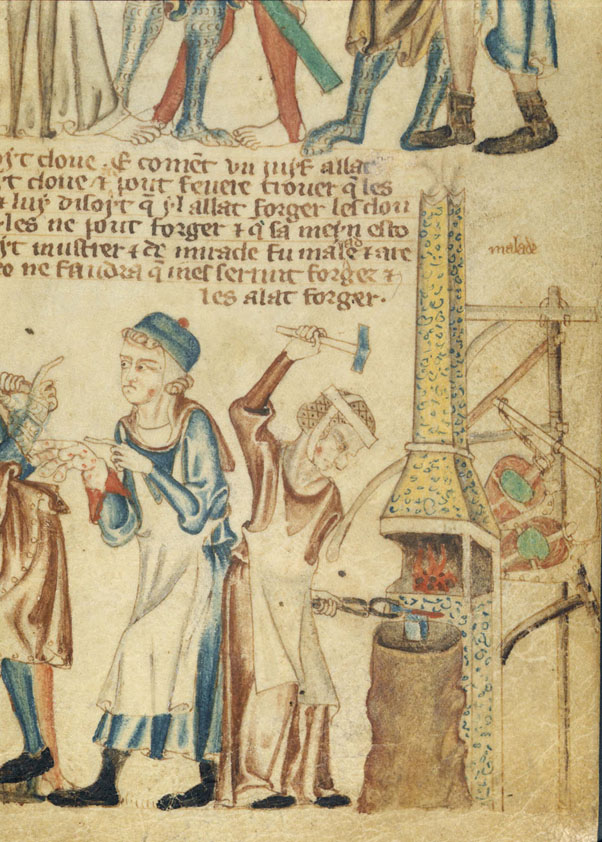
Why am I so sure? To answer that I must take you to the British Library, and open the pages of the Holkham Bible. This is an illustrated book of Biblical stories from the years around 1330, and it is notable for the extent and quality of its illuminations. All of mediaeval life is there, sharply observed in beautiful colour, for among the Biblical scenes there are contemporary images of the people who would have inhabited the world of whichever monks created it. One of its more famous pages is the one that caught my eye, because it depicts a woman wearing a blacksmith’s apron over her dress while she operates a forge. She’s a blacksmith’s wife, and she’s forging a mediaeval carpenter’s nail. The historians tell us that this was an activity seen as women’s work because the nails used in the Crucifixion were reputed to have been forged by a woman, and for that reason she is depicted as something of an ugly crone. Thanks, unknown mediaeval monk, you really don’t want to know how this lady blacksmith would draw you!
This image and the history behind it have intrigued me for years, to the extent that I’ve eyed up more than a few seven-century-old metal fastenings in my time Until recently though I’d never had a go at making my own, but with a weekend at Hack42 and a portable forge to play with it seemed like an opportune moment to do my nails.
A Brief History Of Nails
The first nails were entirely hand forged from a piece of wrought-iron bar into a tapered point about 6″ (150 mm) long, with a head hand-formed by hammering flat a piece of untapered original stock. These are the nails that the Holkham blacksmith is making, as well as those that I am interested in. There are special dies for forming nail heads into which the point is inserted so the head can be hammered flat, but it is also possible with a little skill to hammer the end flat upon the edge of the anvil.
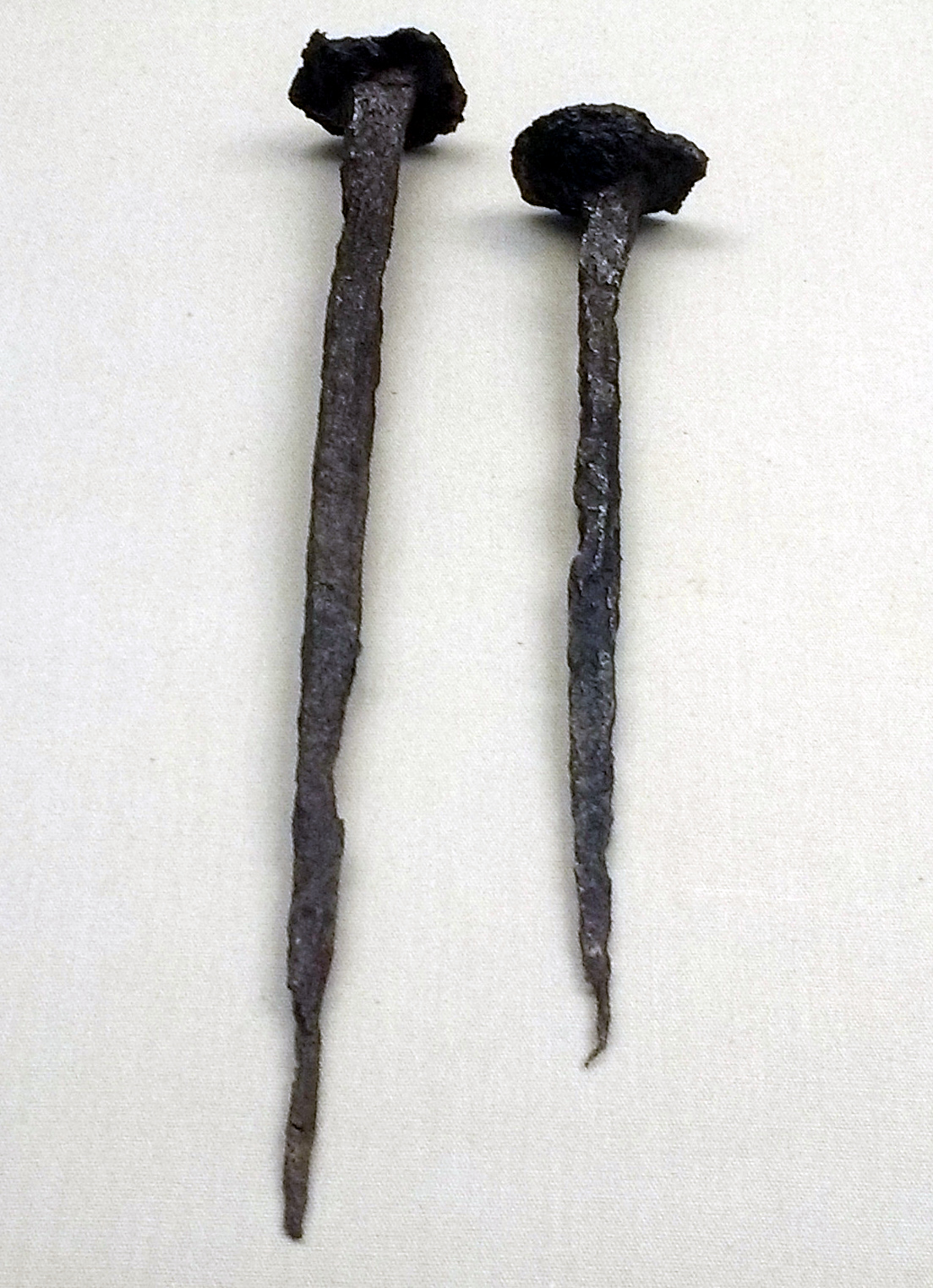
The shape of a nail changed little from Roman times until the first nail-making machinery appeared in the 17th century. Even then, the first machines were designed only to speed up production of these traditional nails, the finished product is very similar to its predecessor. It was around the end of the 18th century when the first significantly different nails emerged, the cut nail, so-called because it was formed as a tapered piece cut from a sheet of metal. These retained the four-sided taper of the hand-forged older nails, but had a much more uniform look. The modern round wire nail appeared in the second half of the 19th century, and because it could be made by automated machinery it quickly displaced the cut nail.
In a sense it’s difficult to properly replicate the hand-forged nails of old in the 21st century because of the lack of the wrought iron they were made from, but the steel nail I can make is functionally equivalent even if it requires a lot more effort to forge. There’s no sense at all in forging a mediaeval nail, but if that were the only criterion I suspect half the awesome stuff we feature on Hackaday would never see the light of day. So picking up a piece of rebar, it’s time to head for the anvil and give this unexpected project a go.
Making the nail
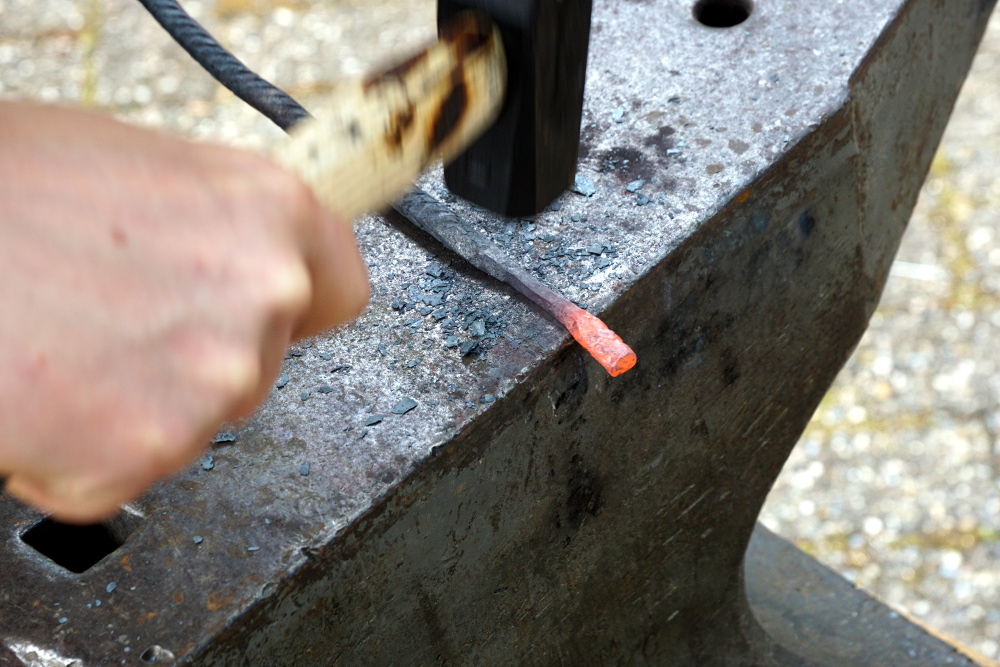
The idea is to take a piece of rebar and forge it to a tapered point with about half its diameter, then cut it off about 10 mm to 20 mm above the start of the tapered section. The resulting “slug” of metal can then be hammered flat to form a nail head, and the result should be a usable nail.
Drawing out the tapered point is a very straightforward process of hammering equally on all sides that shouldn’t detain any smith for long. I tried one brought to a round point and a couple of square points, and I am told that the square one makes for a better nail. The head, by comparison, was not so straightforward, and of the three I produced I didn’t manage to fully form any the way I’d originally hoped to on the edge of the anvil alone.
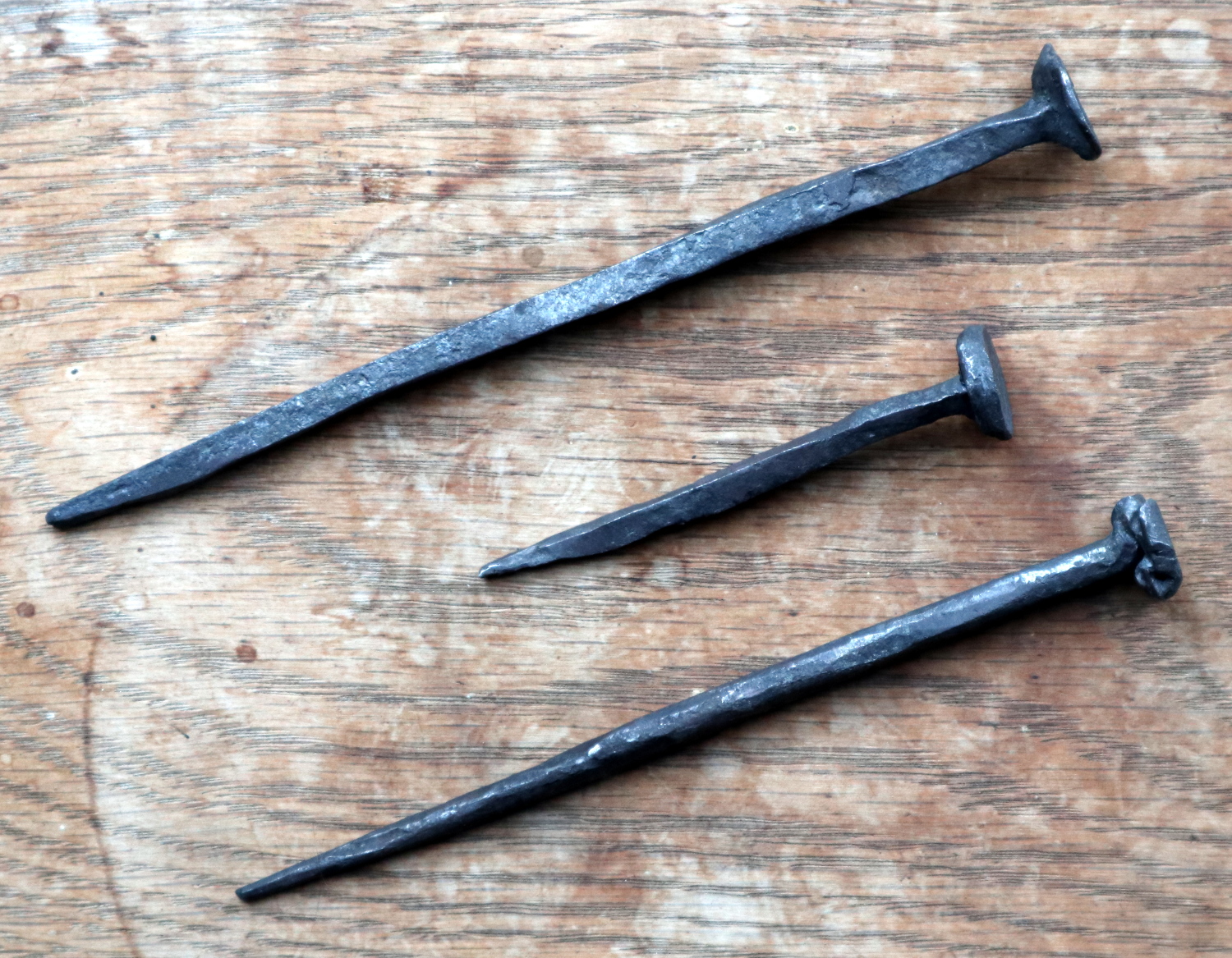
The idea is that I should be able to take my “slug” of metal on the thick end of my taper, hold it against the edge of the anvil, and hammer it at an angle while continuously turning it such that it flattens out. In practice I either didn’t crack the method of holding it against the anvil or I hit it at the wrong angle, and I had to finish it in the leg vice in which I was able to hammer directly down upon it. The mediaeval lady has no leg vice, so in that I failed. Another attempt at a head involved flattening the slug into a spatula-like shape, before bending it at right angles and folding it backwards and forwards to make a head. A success, but not how the real mediaeval nails would have been made.
So having never made a nail before I was able to learn something of the technique and knock out a few of them with relative ease. It’s not quite a truly authentic nail, but I’m getting closer. If there’s one place I’ve gone wrong though it’s one in which the lady in the Holkham Bible would have beaten me hands-down. Each of these nails took me between a quarter hour and twenty minutes to make, while she would have been able to knock out one a minute. Maybe I’m not quite up to historical recreation standard after all.
Header image: © Martina Short, used here with permission.