Imagine what it must have been like for the first human to witness an aurora. It took a while for our species to migrate from its equatorial birthplace to latitudes where auroras are common, so it was a fairly recent event geologically speaking. Still, that first time seeing the shimmers and ribbons playing across a sky yet to be marred by light pollution must have been terrifying and thrilling, and like other displays of nature’s power, it probably fueled stories of gods and demons. The myths and legends born from ignorance of what an aurora actually represents seem quaint to most of us, but it was as good a model as our ancestors needed to explain the world around them.
Our understanding of auroras needs to be a lot deeper, though, because we now know that they are not only a beautiful atmospheric phenomenon but also a critical component in the colossal electromagnetic system formed by our planet and our star. Understanding how it works is key to everything from long-distance communication to keeping satellites in orbit to long-term weather predictions.
But how exactly does one study an aurora? Something that’s so out of reach and so evanescent seems like it would be hard to study. While it’s not exactly easy science to do, it is possible to directly study auroras, and it involves some interesting technology that actually changes them, somehow making the nocturnal light show even more beautiful.
Sounding Off
For all that we’ve advanced our knowledge of natural phenomena, auroras are still a bit of a mystery. We know the basics, of course: auroral displays occur when the pressure of the solar wind, that stream of charged particles flowing outward from the Sun, increases to the point that it can penetrate the Earth’s magnetosphere. When that happens, oxygen and nitrogen about 80 km above the surface are ionized, releasing photons of visible light in the process. The amount of light and its color are characteristic of the amount of energy streaming in from the sun.
Surprisingly, it was only relatively recently that the exact cause of auroras was determined. Prior to 1960, scientists didn’t know that the ionization was due to an influx of particles from the Sun, which was only learned once it was possible to put instruments into active auroras. The experiment was performed as part of the International Geophysical Year (IGY), a series of cooperative Earth sciences experiments conducted by 67 nations in 1957 and 1958 and highlighted by the world’s first artificial satellite, Sputnik.
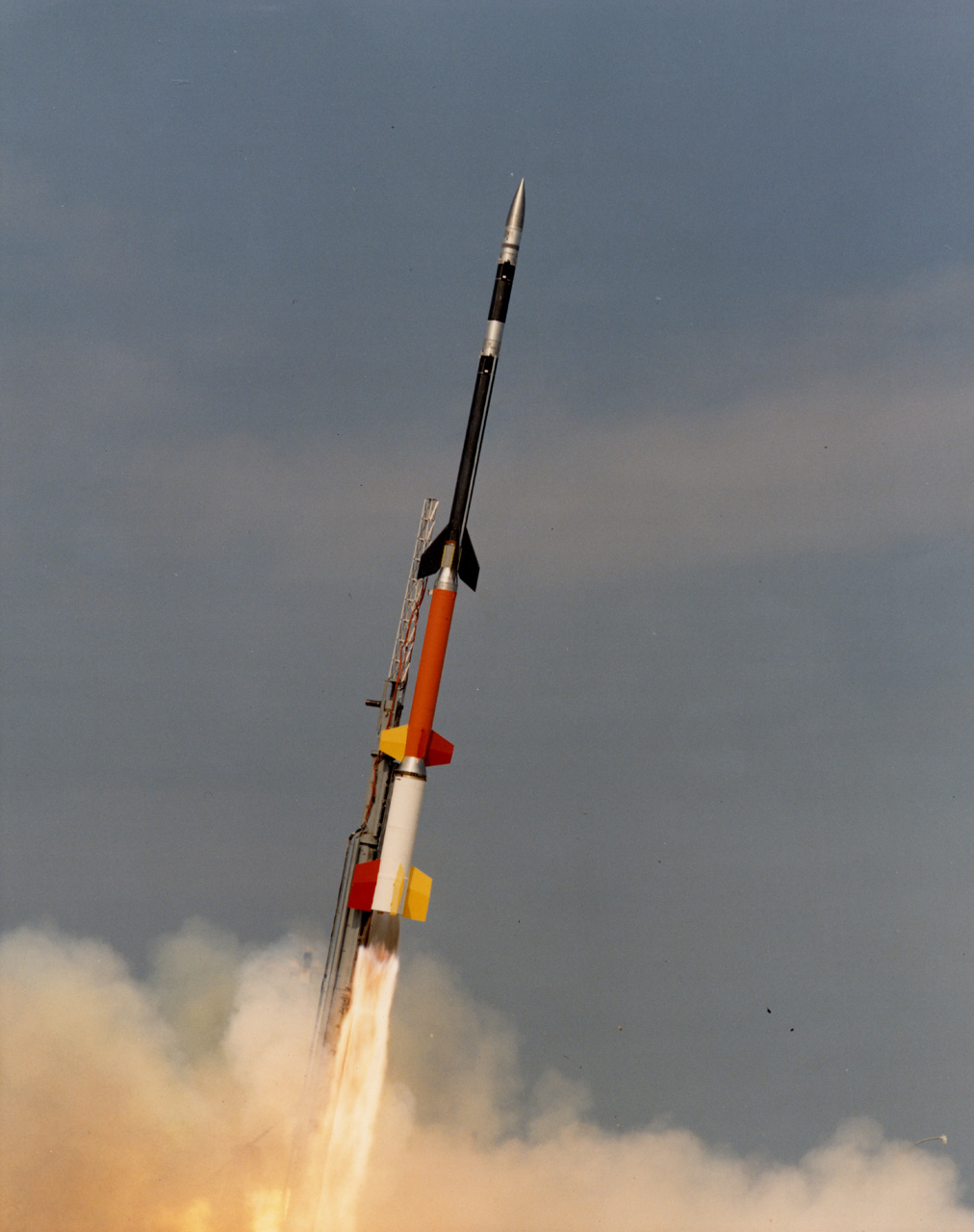
The vehicle of choice for accessing the edge of space during the IGY experiments, and in fact ever since, is the sounding rocket. Sounding rockets are small rockets, at least in comparison to rockets intended to lift heavy payloads into orbit. Sounding rockets are generally solid-fueled, multistage vehicles with a limited payload capacity and usually limited to an altitude of 50 to 150 km. They’re far cheaper to launch than orbital missions, but their ballistic trajectories only give researchers a small window of time to gather data, usually while the rocket is at apogee.
Auroras on Demand
Sounding rockets have proven themselves time and again over the last 60 years for high-altitude missions, including many aimed right into active auroras. The recent AZURE mission was one that scored a spectacular bullseye on an aurora over Norway. The Auroral Zone Upwelling Rocket Experiment was designed to explore the vertical flow of particles in the ionosphere and used an interesting technique to achieve it. Launched from the Andøya Space Center on the northern coast of Norway, the Black Brant XI-A sounding rocket was equipped with a special tracer release package. At apogee, the rocket released trimethyl aluminum (TMA), an organoaluminum compound commonly used in semiconductor manufacture. The TMA reacts with oxygen and produces chemiluminescent clouds that can be observed easily from the ground. A mixture of barium and strontium was also released, which was quickly ionized and produced a similar cloud. The releases essentially created small artificial aurora for the researchers to observe as they drifted in the wind.
The two launches produced spectacular images that were captured by the researchers and nearby residents alike.
AZURE is only part of a series of experiments designed to study how auroral energy is distributed by vertical winds within the ionosphere. There are more launches planned, so the fireworks over Norway and at other sounding rocket launch facilities will continue for some time, as the beauty of natural auroras is complemented by rockets leaving behind their telltale trails.