Regular Hackaday readers will know that the clearance section of your local big box retailer is a great place to pick up oddball gadgets and gizmos for dirt cheap. In an era where manufacturers are rushing to make their products “smart” whether they need to be or not, the occasional ideas which fail to gain traction are just the cost of doing business. If you keep an eye out, you’re almost guaranteed to see one of these Internet of Things rejects collecting dust on a back aisle, often selling for pennies on the dollar.

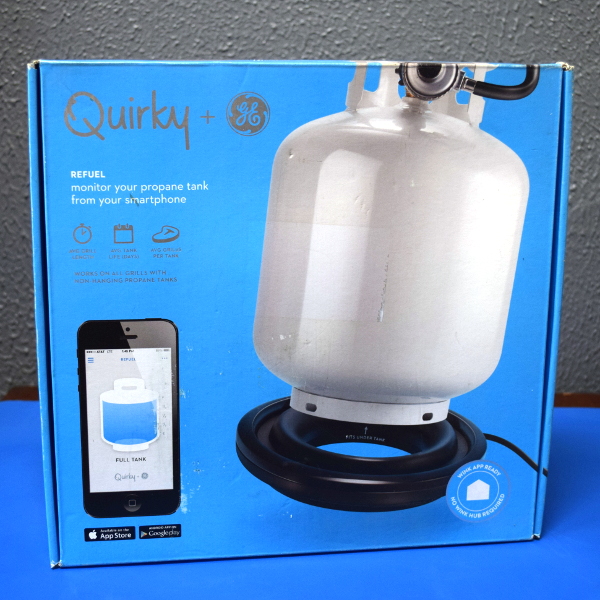
Case in point, the “Refuel” propane tank monitor from Wink. Though there’s also logos for Quirky and GE on the package as well, and even a picture of the guy who came up with the idea. Essentially what we have here is a digital scale that reports the current weight of your grill’s propane tank to your phone via the Internet. A trick we might consider a fairly simple hack with a load cell and an ESP8266 under normal circumstances, but as this is a commercial product with an MSRP of $49.99 USD, its naturally been over-complicated to the point of absurdity.
Of course, one could simply lift the propane tank and get a decent estimate of its contents; a trick mastered by weekend grill masters since time immemorial. But then you wouldn’t have to make an account with Wink, or go through the very strange process of attempting to configure the device by using the flashing light of your smartphone’s screen (seriously). All so you can check how much propane is left in your grill while you’re away from home. You know, as one does.
Frankly, it’s hard for me to imagine who would actually have purchased such a thing at full retail. But of course, that’s likely why I was able to pick it up for the princely sum of $5. At that price, we can’t afford not to take a peek into this gizmo from Wink, Quirky, GE, and Anthony from Boston.
Imp Inside
The Refuel consists of two primary components: the scale itself, and the base unit (for lack of a better term) that actually connects it to the WiFi network. The base unit has a magnetic backing which allows the user to stick it to the frame of the grill, and is linked to the scale with about one meter of flat cable that is separated in the middle by a waterproof connector.
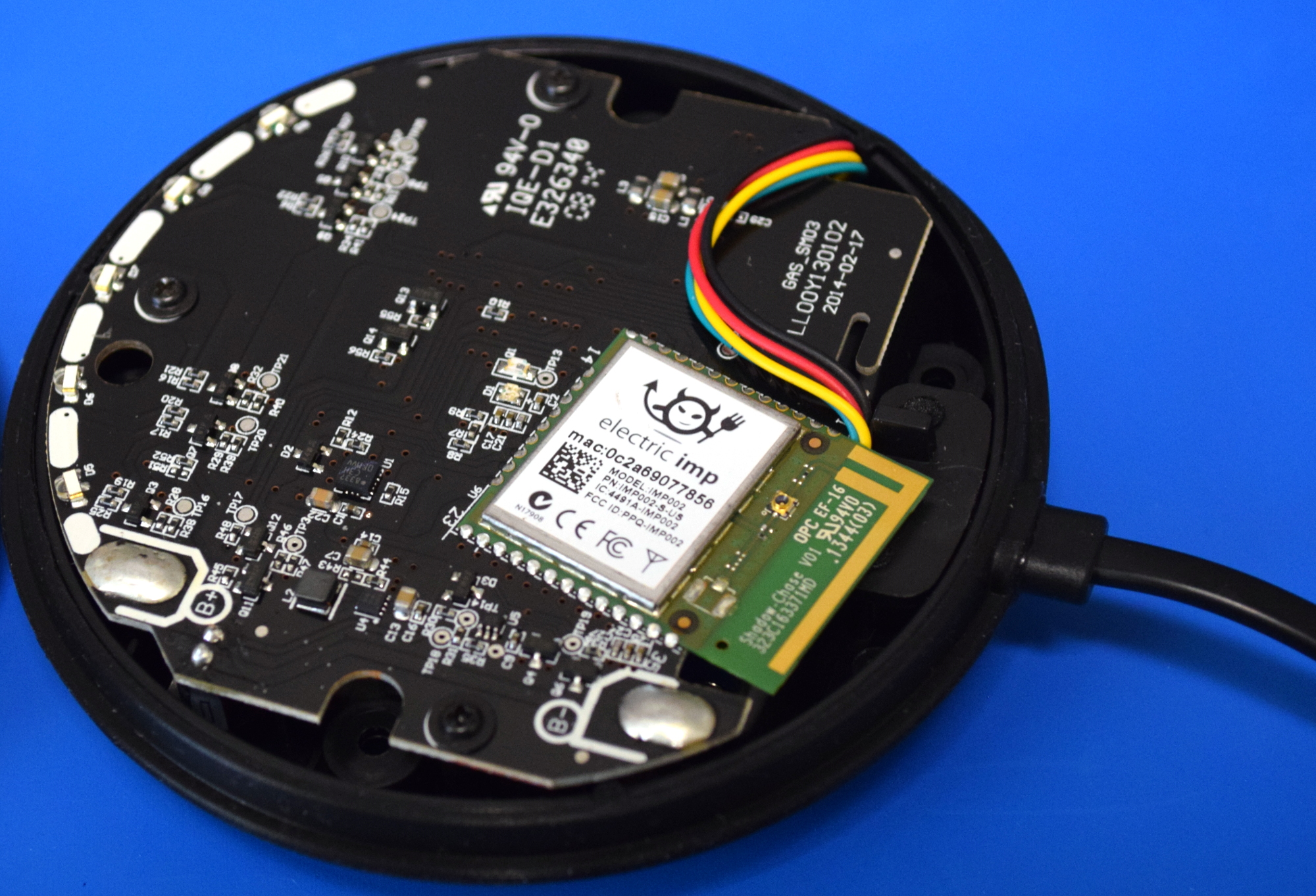
Upon opening the device up, we’re greeted with quite a surprise indeed: inside there’s a rather jauntily positioned Electric Imp module. Specifically, the now obsolete (but still available for purchase at the time of this writing) IMP002. Long before the ESP8266 was even a twinkle in the hacker’s eye, these 32bit WiFi-enabled modules promised to be one of the easiest ways to get your hardware projects online. We’ve seen some very impressive builds centering around Electric Imp boards since then, and it’s nice to see first hand that they’ve made inroads in the consumer electronics space.
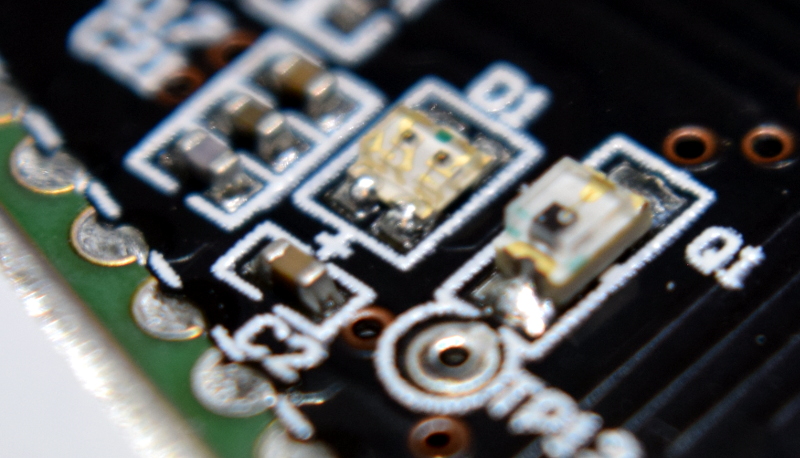
In hindsight, the screen blinking configuration scheme should have been a huge hint about what was powering this device. This capability is known as “BlinkUp” in Electric Imp parlance, and is advertised as a way for end users to quickly and easily configure their device with their smartphones. It avoids the security implications of setting up a temporary WiFi Access Point the user needs to connect to, but unfortunately can be somewhat finicky as so much depends on the environment.
It’s clear that the IMP002 module is the star of the show here, as the rest of the PCB is nearly bare. Most of the other components are devoted to driving the array of bi-color LEDs on the edge of the board, which are used to show a rough “fuel gauge” on the unit itself so you don’t always have to break out the phone.
A Whale of a Scale
I presumed that the scale portion of the Refuel would be a load cell of some type, and felt especially confident when I saw the four wire cable. The last thing I expected to see inside was a trio of Hall effect sensors, matching spring-mounted magnets, and some mystery electronics.
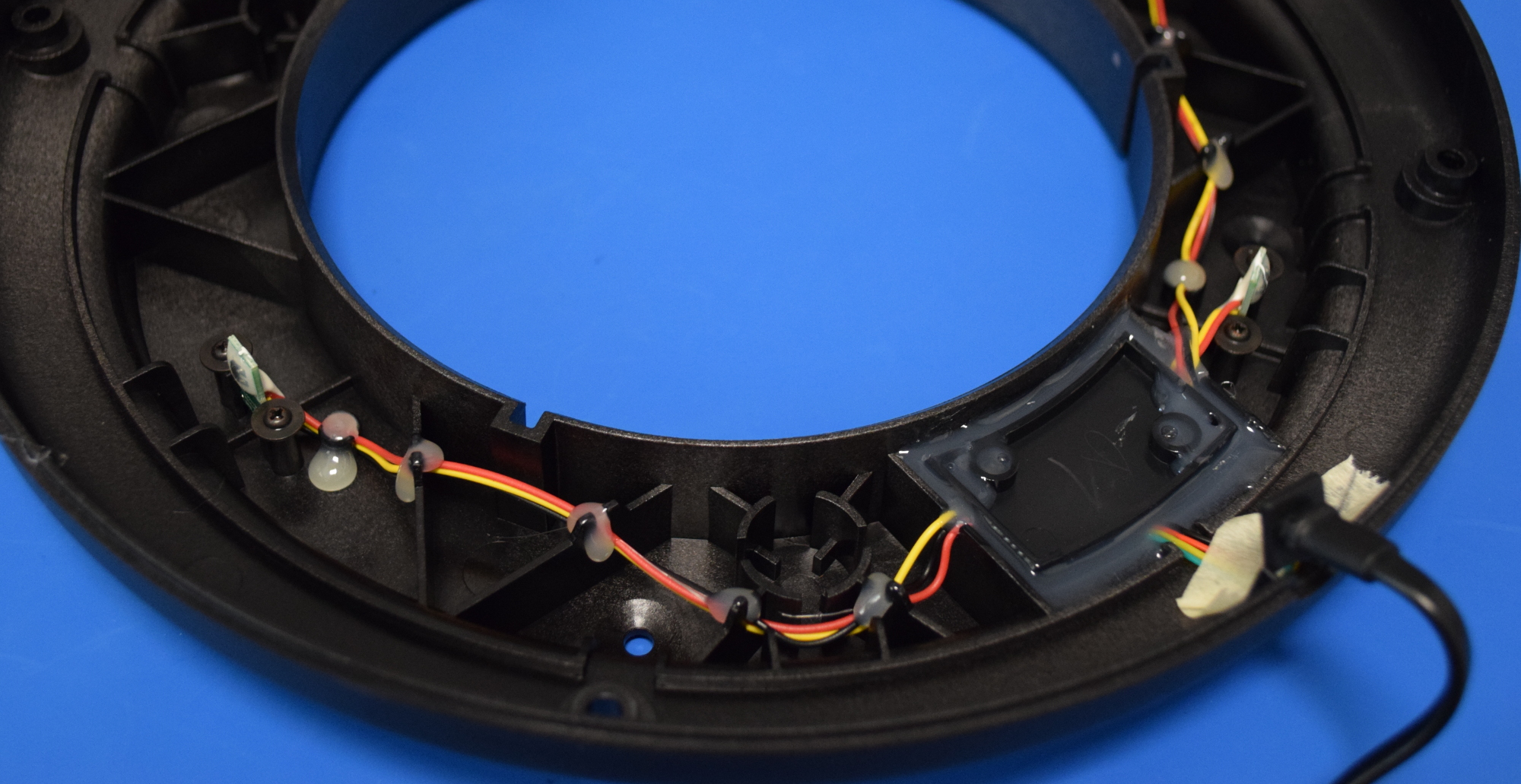
The three sensors are oriented in a triangle configuration, clearly to get a more accurate read on the tank’s weight. Each Hall effect chip is mounted on a tiny silk screened PCB and has been lovingly encapsulated in epoxy to protect them from the elements. For something that I had assumed was only a step above a novelty gift at first glance, the construction here is really quite impressive.
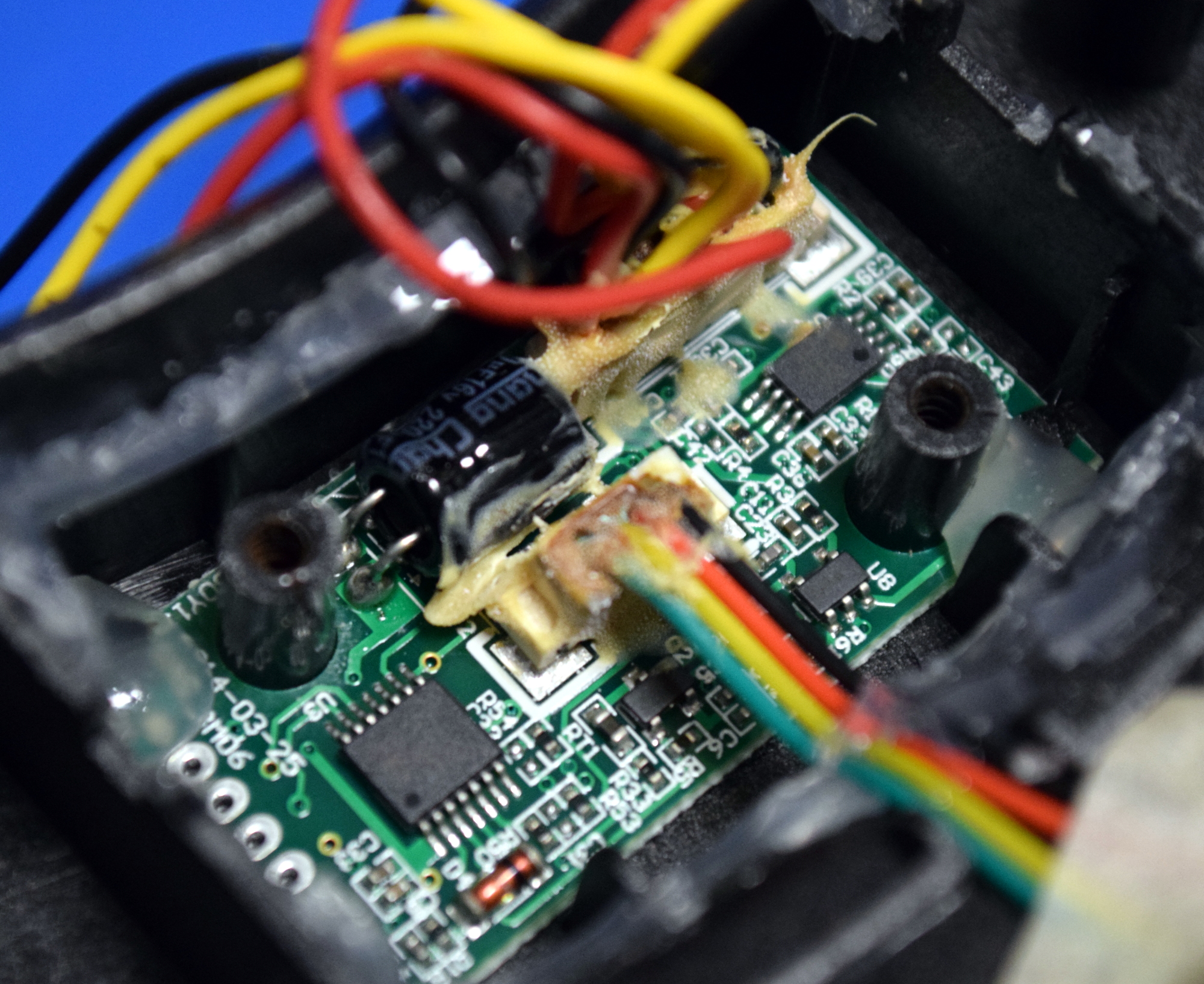 All of these sensors are connected to a potted box directly under where the wire from the base unit comes into the scale. Obviously there’s some trickery going on inside of this compartment, and I’ll admit that the prospect of digging through that sealant was almost enough for me to just leave it sealed up, but the readers of Hackaday deserve better than that; we must have answers. So I loaded “lofi hip hop radio – beats to relax/study to” on YouTube and got to work with a sharp blade.
Inside was a fairly dense little PCB complete with a PIC16F1823 microcontroller. I didn’t pry it out of the shell since it appeared to be glued down pretty well, but just seeing that MCU on there is enough to tell us everything we need to know. The chip is reading the raw data from the three Hall effect sensors, processing it, and sending it up to the Electric Imp digitally. One could argue that the scale isn’t really a sensor so much as an independent piece of equipment which is working in conjunction with the base station.
Heavyweight Communications
So we have four wires connecting the scale to the base station: we know two of them are power, and two of them are data. My first guess was I2C since we’ve seen that in other commercial products which used drop-in wireless modules like this, but turns out it was basic UART. It even seems some of the data is in plain ASCII, though I haven’t quite figured it all out.
Approximately 15 seconds after it’s powered up, the base station sends the character “V” to the PIC16F1823, and receives a reply which appears to be the version number of the scale’s firmware. The base station then makes a dozen sequential requests for data from the scale, presumably some kind of calibration table. After this exchange, normal operations begin.
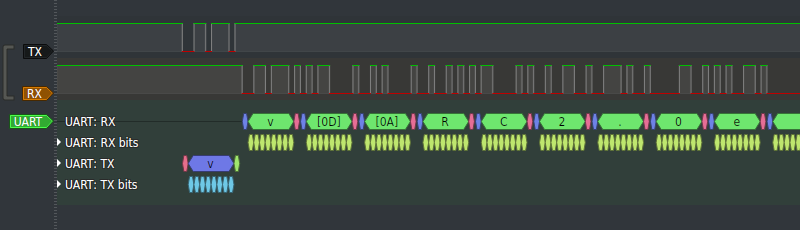
From this point on, every 1.5 seconds the base station and scale exchange a heartbeat signal (the letter “A”) to verify both of them are alive and kicking. This brief handshake is followed by an unsolicited ten byte packet from the scale which presumably represents the current tank weight. Unfortunately I haven’t quite deciphered how this value works, as this seems like more data than should be required for a scale that only goes up to 20 pounds.

If the protocol was decoded fully, then the electronics in the base station could be swapped out with a standard microcontroller should anyone want the ability to weigh their propane tank remotely without necessarily buying into the Wink ecosystem. It would also be a simple matter to reuse the scale in a different project entirely, though I’m not really sure how many other potential applications there are for this particular measuring device.
Built Like a Steakhouse
 I still don’t think this product is practical. That being said, I’ve got to admit this thing surprised me. I expected an ill-designed piece of hardware that was put together by the lowest bidder, but it ended up being one of the best built products I’ve had the pleasure of dissecting. The phrase “You get what you pay for” generally has a negative connotation, but I think it’s safe to say the Wink Refuel can be added to the short list of gadgets that earned their price tag.
I don’t know if that comes as any consolation for those who spent fifty bucks so they look longingly at how many steaks they could be cooking if it wasn’t for the fact they were stuck at work, but I certainly don’t regret coughing up the $5 to tear it apart.