The United States is going back to the moon, and it’s happening sooner than you would think. NASA is going back to the moon in 2024, and they might just have the support of Congress to do so.
Getting to the moon is one thing, and since SpaceX launched a car to the asteroid belt, this future of boots on the moon after Apollo seems closer than ever before. But what about landing on the moon? There’s only ever been one Lunar Lander that has taken people down to the moon and brought them back again, and it’s doubtful that design will be used again. Now, Lockheed has their own plan for landing people on the moon, and they might be able to do it by 2024.
The Mission
Currently, NASA’s plan to put a man on the moon revolves around a plan that is entirely unlike Apollo. Instead of sending a command module and a lunar lander for a one-off journey to the surface of the moon, future astronauts will arrive to the moon by first going through a gateway. This Lunar Gateway is a space station in a weird orbit that looks like a highly eccentric polar orbit around the moon, with an orbital period of between six and eight days. Mathematically, it’s an orbit around an Earth-Moon Lagrange point and does take a bit more fuel to access than a purely lunar orbit. However, this orbit is extremely favorable for many things that aren’t lunar landings. First, the orbit allows for continuous communication with Earth, and can serve as a relay for operations on the far side of the moon. The entire surface of the moon is accessible from this orbit, unlike the Apollo missions which could only access the low latitudes of the moon. This last point is especially important, as there are plans to put boots on the South Pole of the moon, which has proven reserves of water ice. But to get to the surface, you need a lander, and there are a lot of options available.
The Lander
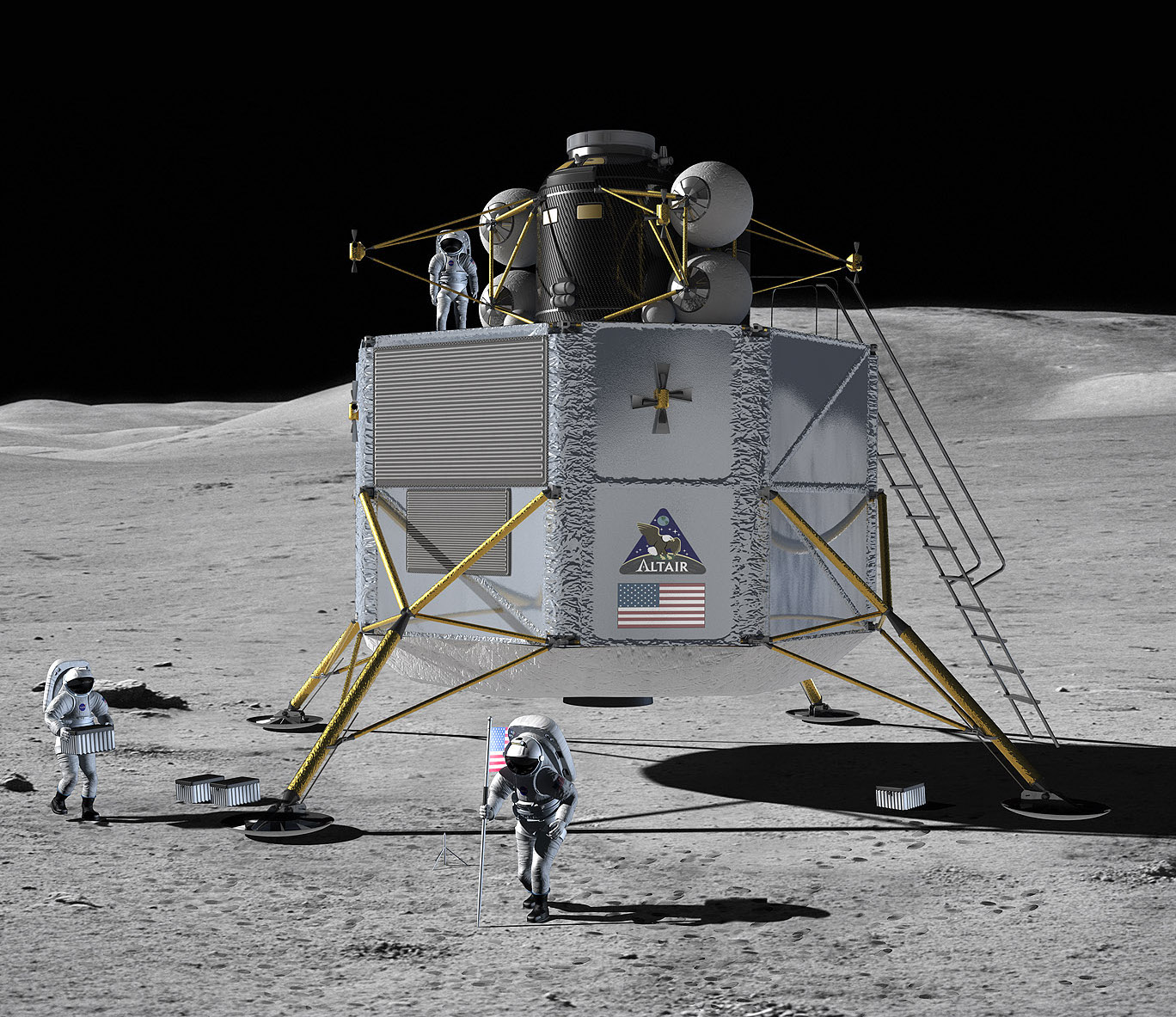
Over the past 10 or 15 years, there have been many proposals for the next generation of spacecraft to land on the moon. The first, and biggest, was an outgrowth of the Constellation Program. The Altair lunar lander was a massive, three-story-tall vehicle capable of supporting four astronauts on the moon for a week. There’s an airlock, unlike the Apollo lunar lander, and a cargo variant would be able to put almost fifteen tons of equipment, habitat modules, or supplies anywhere on the surface of the moon. The Altair is an exceptional vehicle, but after the Constellation program was cancelled in 2010, plans for the lander died on the vine.
In the years since the cancellation of the Constellation program, the plans for a lunar lander have evolved. No longer will astronauts repeat the mission profile of Apollo by flying off to the moon, docking with a lander on the way, entering an equatorial orbit around the moon, heading down to the surface, going back up again, and finally heading back to Earth. The plan now is for a lunar gateway, and this requires a different type of lander.
Currently, Lockheed Martin is working on an Orion-based lander concept that is well suited to getting to the moon through a lunar gateway. The lunar part of this lander is about what you would expect — there’s a decent module with a big engine and spider-like legs. On top, there are living quarters that also have an engine to return to lunar orbit. Unlike other plans which involve what is effectively a three-stage lander (with the first stage used to get the craft to the moon), the Lockheed lander will be two stages, based on common parts, and be able to bring a lot of mass down to the lunar surface.
Is It Actually Possible To Build This?
Lockheed’s lander is a proposed lunar lander that will allow astronauts to put bootprints on the moon within about five years or so. That’s not a lot of time, especially when it comes to aerospace. Nevertheless, NASA thinks this can happen by 2024. Is it actually possible to build a lunar lander in such a short amount of time? History says yes.
The development of the original Lunar Lander started in late 1962, with the NASA contract going to Grumman. The design goal for this lunar lander was simply to take two astronauts down to the surface of the moon and return to lunar orbit; the implementation was very much open to interpretation because no one quite knew how to build a lunar lander. The design was set in 1963, with Grumman building the first test landers, and in March of 1969, the Lunar Module actually flew, with astronauts inside, with Apollo 9. The Lunar Module would orbit the moon two months later with Apollo 10, and two months after that, Apollo 11 would perform the first manned mission to the surface of the moon. The design, development, testing, and launch of the first Lunar Lander was only six or seven years, and that’s starting from scratch.
It may very well be possible to build a Lunar Lander to arrive on the moon by 2024. We have computers now, and we know you don’t need gigantic windows. Engines already exist, and space has become commoditized. There are earlier designs to draw from. Still, Rob Chambers, director of human space exploration strategy for Lockheed Martin, says “We need to be bending metal next year”. Someday soon, and maybe sooner than we think, there may be a Lunar Lander assembly line, ready to take cargo and crew back to the moon.