Last month we marked the 40th birthday of the CD, and it was as much an obituary as a celebration because those polycarbonate discs are fast becoming a rarity. There is one piece of technology from the CD age that is very much still with us though, and it lives on in the standard for sending serial digital audio between chips. The protocol is called I2S and comes as a hardware peripheral on many microcontrollers. It’s a surprisingly simple interface that’s quite easy to work with and thus quite hackable, so it’s worth a bit of further investigation.
It’s A Simple Enough Interface
Don’t confuse this with the other Philips Semiconductor protocol: I2C. Inter-Integrated Circuit protocol has the initials IIC, and the double letter was shortened to come up with the “eye-squared-see” nomenclature we’ve come to love from I2C. Brought to life in 1982, this predated I2S by four years which explains the somewhat strange abbreviation for “Inter-Integrated Circuit Sound”.
The protocol has stuck around because it’s very handy for dealing with the firehose of serial data associated with high-quality digital audio. It’s so handy that you’ve likely heard of it being used for other purposes than audio, which I’ll get to in a little bit. But first, what does I2S actually do?
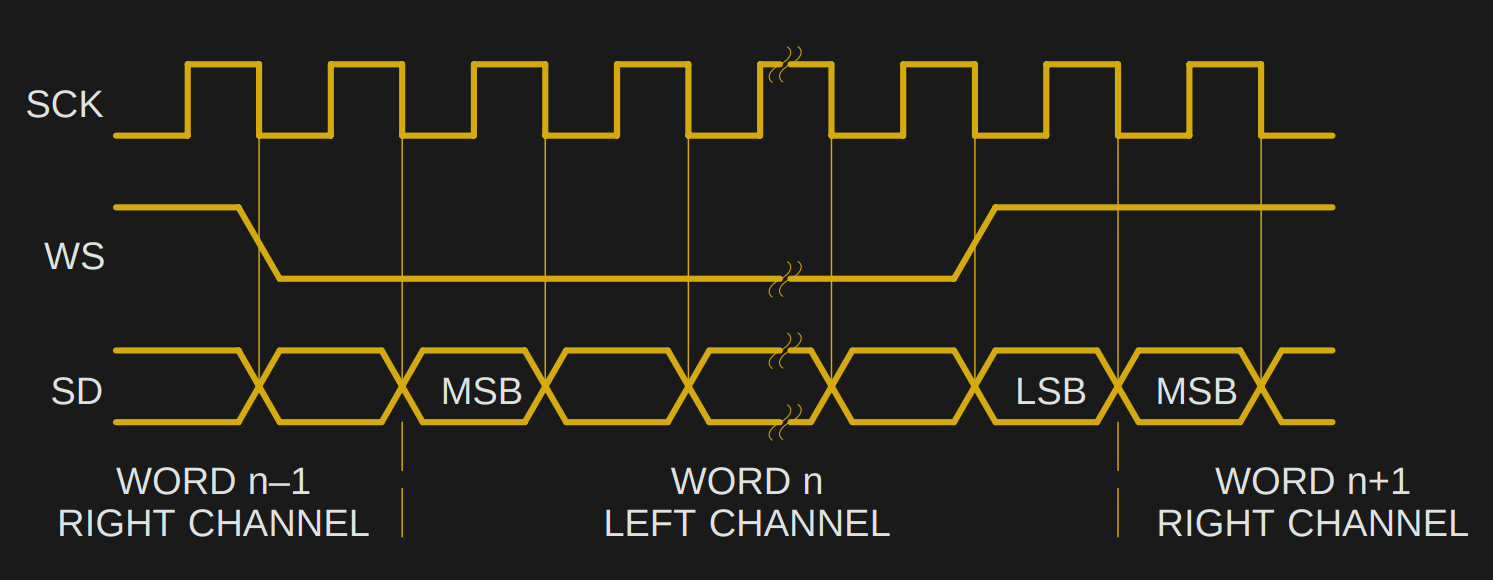
A digital audio source will usually create two words of data, one for the left channel and one for the right, once for every sample interval. For example, a CD audio source with a 44.1 kHz sample rate that will deliver two 16-bit words 44,100 times every second. On a single serial line this is a whopping 1,411,200 bits per second (44100 x 16 x 2).
How does that poor serial data line keep up? Well, a single serial data line cannot easily convey the word boundaries for left and right samples. It is also difficult (or impossible) to reliable retrieve a clock from it without jitter. So for transmitting audio we really need some other means of delivering those pieces of information.
I2S solves both of these problems with extra lines, providing a word select line (also sometimes called L/R clock) to select left or right samples, and a bit clock line to keep everything in sync. That’s all there is to I2S: a data line, a word clock line, and a bit clock line.
The specification was formalised by Philips in a 1986 document that made it through the company’s semiconductor division becoming NXP, but sadly has disappeared from the NXP website. Happily the Wayback Machine has it though, so it is still available. Reading the document it becomes apparent that even in the 1980s this was not a difficult interface to work with, and it even gives basic diagrams for a transmitter and receiver. It’s not impossible to imagine that given some TTL chips and a resistor ladder it should be possible to build an I2S DAC from first principles on your bench, albeit not a very high-performance example.
Where We’re Going, We Don’t Need Audio
![The seemingly impossible: [cnlohr]'s feat of making an ESP8266 do wired Ethernet.](https://playingwithsteam.com/wp-content/uploads/2019/04/10baset-on-esp8266-featured.jpg)
So there you have it: I2S. All you need to know about inter-chip audio interconnects, in four handy paragraphs. What more is there to understand?
As it happens from the point of view of the work we cover at Hackaday the digital audio origins of I2S are only the start. It is both a loose and a simple specification that is easy to implement, and equally easy to abuse. For example, it does not specify an upper limit for the clock rate. Naturally, its potential as a very fast serial output has led hardware hackers to use it for other purposes. We’ve seen it pressed into service as an AM radio transmitter, an NTSC video output, a VGA output, and even an Ethernet card. How on earth are they doing that!
The answer lies in pulse density modulation, a form of analogue to digital conversion in which the number of logic 1 bits in a given time period depends on the level of the analogue signal. This is the raw output of a delta-sigma ADC, and it has the handy property that given only a PDM data stream the digital to analogue conversion step can be performed with only a simple low-pass filter. If you crank up the bitrate on an I2S interface as far as it will go and then feed it words that form a PDM data stream, you can add a low-pass filter to create an ADC with a maximum bandwidth of half its bit rate.
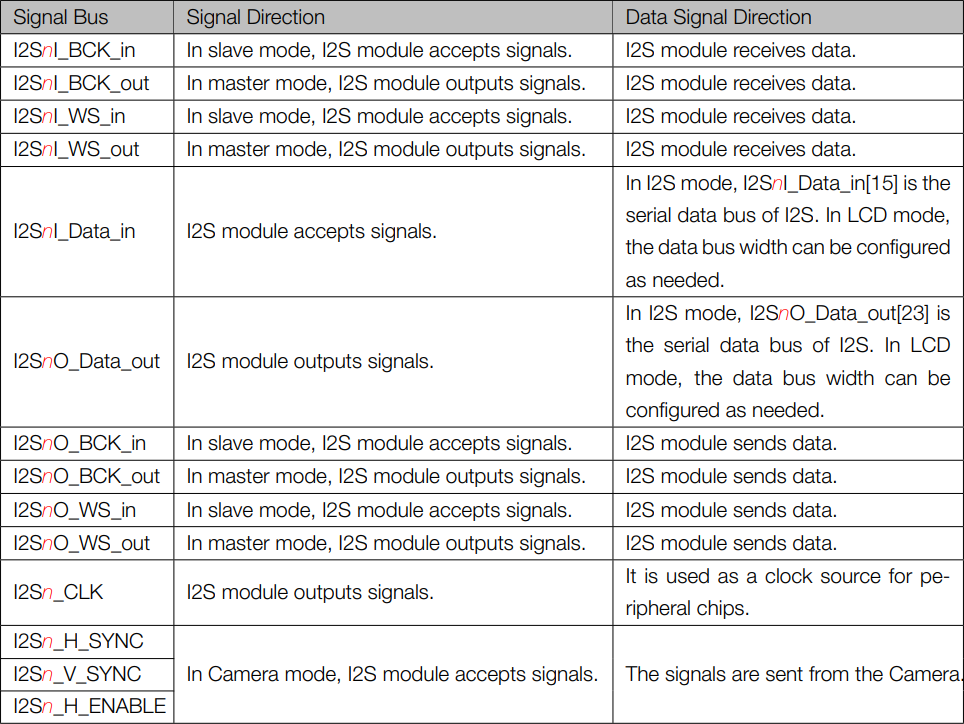
There’s an addendum to the list of example projects above using I2S, and it concerns some of those we haven’t featured. The ESP32 has an I2S module, and through it have come some impressive projects such as this full-colour VGA generator. At risk of skirting controversy though, these projects are not using I2S in the strictest sense. The ESP32 technical reference manual page 303 sheds some light on this, revealing that the I2S peripheral in the Espressif part is multifunctional. As well as handling audio I2S as described above, it also handles interfaces for cameras and LCD displays, it’s as though you were to imagine the camera and LCD connectors on a Raspberry Pi routed to the same piece of silicon. Perhaps this nomenclature has its roots in the ESP8266 having an I2S peripheral on chip (page 71), and the shared peripheral in the later device inheriting the moniker. Either way it might be I2S ESP32-style, but in those two other interfaces it’s not I2S Philips serial PCM audio-style.
Because most I2S interfaces can work with clock rates into the many megahertz, their bandwidth can be surprisingly high. It’s the same as the principle behind any software-defined radio transmitter: at a stroke and with very little extra hardware you have transferred the task of creating arbitrary spectra in the MHz range from hardware to software. Even the most pedestrian of modern microcontrollers have enough computational power for the task, rendering relatively straightforward some applications for I2S that would have been beyond the imaginations of those Philips engineers of the 1980s. Suddenly that one-trick pony to which you could only hook up an audio DAC becomes a lot more useful, and the possibilities are endless.
Header image: Philips TDA1541A 4x oversampling I2S DACs in a CD player. Cjp24 [CC BY-SA 3.0].