I couldn’t decide between normal and decaffeinated coffee. So to eliminate delays in my morning routine, and decision fatigue, I’ve designed the Schrödinger Quantum Percolator — making the state of my coffee formally undecidable until I drink it.
At its core, the Quantum Percolator contains a novel quantum event detector that uses electron tunneling to determine whether to use caffeinated or decaffeinated coffee. The mechanical components are enclosed in an opaque box, so I can’t tell which type of coffee is being used.
The result is coffee that simultaneously contains and does not contain caffeine – at least until you collapse the caffeination probability waveform by drinking it. As the expression goes, you can’t have your quantum superposition of states and drink it too!
Offloading Personal Decision to Quantum Theory
The quantum event detector is an array of avalanche diodes cooled to a low temperature so that electron tunneling noise supersedes thermal electron noise as the dominant noise source. Even with the high amplification factor of the avalanche diodes (about a million), only a tiny current is produced by the array. Also, it looks really cool when it catches the light just right.

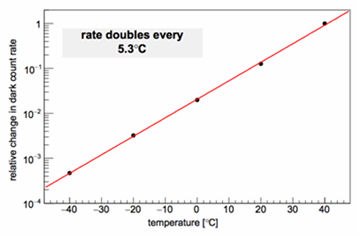
The next stage, a transimpedance amplifier built around the OPA656, uses a high speed op-amp to convert this small current to a usable voltage.
Up to now, the entire device is built within a thermally insulated Faraday cage, using low-temperature tolerant components (e.g. automotive or medical rated), and on aerospace-grade copper clad Kapton PCB. A water-cooled Peltier effect heat pump lowers the temperature of this component to around 245 degrees Kelvin. One neat benefit of this type of PCB material is that it has a very low thermal mass as a result of being so thin, so the cooling stages don’t have to deal with a lot of thermal mass.
The output of this system is then pulse-shaped with a CD4069UBE Schmidt-trigger hex inverter. The time between these pulses is sampled using the 16-bit timer of an ATtiny2616 microcontroller. For any given three pulses, if the time between the first two is greater than the time between the second two, the serial port will output ‘1’. In the opposite case, it will output ‘0’. In the rare event the times are equal, no output will be generated.
Having My Coffee… And Drinking it Too
When the coffee machine is activated, it uses the quantum event detector as input to brew either caffeinated (1) or decaffeinated (0) coffee.
I’ve always preferred quantized foods — a steamed bun if I want one of something, dumplings if I want 10, noodles if I want 100, and rice if I want 1000. Beverages were always problematic in this regard, so I’m quite happy to in some way finally have quantum coffee — even if I can still drink only half of it, although this remains largely theoretical and has never been observed in nature.