The Compact Disc is 40 years old, and for those of us who remember its introduction it still has that sparkle of a high-tech item even as it slides into oblivion at the hands of streaming music services.
If we could define a moment at which consumers moved from analogue technologies to digital ones, the announcement of the CD would be a good place to start. The public’s coolest tech to own in the 1970s was probably an analogue VCR or a CB radio, yet almost overnight they switched at the start of the ’80s to a CD player and a home computer. The CD player was the first place most consumers encountered a laser of their own, which gave it an impossibly futuristic slant, and the rainbow effect of the pits on a CD became a motif that wove its way into the design language of the era. Very few new technologies since have generated this level of excitement at their mere sight, instead today’s consumers accept new developments as merely incremental to the tech they already own while simultaneously not expecting them to have longevity.
The Origins Of The Format
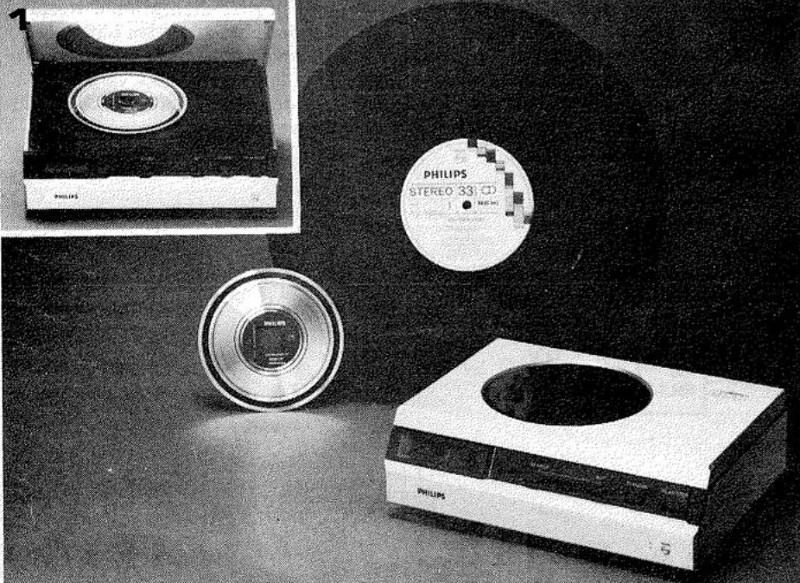
The format had its roots in contemporary consumer video technologies, with which in parallel research programmes both Sony and Philips were working on next-generation audio products. Sony had showcased a digital audio system using its video tape format in the early 1970s, while Philips had investigated an analogue system similar to LaserDisc video discs. By the middle of the decade both companies had produced prototype optical audio discs that were not compatible but were similar enough for them to investigate a collaboration. The 1979 prototype players with their 120 mm polycarbonate discs containing over an hour of 44.1 kHz 16-bit stereo audio were the result, and books and magazines with a futuristic outlook featured the prototype players along with the inevitable rainbow shot of a CD as the Way of the Future.
TV shows such as the BBC’s Tomorrow’s World made extravagant claims about the new format’s durability compared to vinyl LPs, leading to an expertly marketed fever pitch of expectation The Philips silver top-loading player might have looked good, but consumers would have to wait a few more years until 1982 before the first commercially available models hit the stores.
How Does A CD Player Work?
The CD player’s mode of operation might have seemed impossibly high-tech to the general public in 1980, but when it is laid out into its fundamentals it is refreshingly understandable and considerably simpler than the analogue VCR so many of them would have sat next to in an ’80s living room. At the end of the 1980s it was the example used to teach all sorts electronic control topics to electronic engineering students at my university, when we were all familiar with the format but probably most of us didn’t have the cash to own one of our own.
![An annotated picture of the CD player laser assembly. Zim 256 [CC BY-SA 3.0]](https://playingwithsteam.com/wp-content/uploads/2019/03/philips_1_beam_tracking_laser_optical_assembly.jpg)
The business end of a CD player has surprisingly few moving parts. It is contained in a combined laser and sensor module which is mounted on a sliding actuator usually driven via a worm drive by a small motor. An infra-red laser diode shines into a prism which directs its light downwards at right angles through a lens towards a spinning CD. The lens has a focus mechanism, usually a set of coils and a magnet, allowing it to float on a magnetic field. Light is reflected back from the CD and passes directly upwards through the prism to land on an array of four photodiodes. At ideal tracking and focus the reflected light should be concentrated in the centre of the array, so by monitoring the current produced by each photodiode the player can adjust the focus, disc speed, and linear position of the laser module to keep everything on the track and retrieving a clean data stream at the right data rate.
The analogue signal from the diode array contains the data stream produced as the beam traverses the pits and lands on the CD, and a one-bit front-end simply digitizes these into bits.. These bits are assembled into data frames that have been encoded in a form designed to maximise the recoverability of the stream by encoding each byte of data into a 14-bit word intended to reduce the instantaneous bandwidth of the stream by avoiding single logic ones and zeros. This decoding is performed using a look-up table, resulting in a 16-bit data stream with Reed-Solomon error correction applied. The error correction step is performed, and the result is fed to a DAC to produce the audio signal. There are many variations and enhancements to the system that have been created by various manufacturers over the years, but at its heart the CD player remains a surprisingly simple device.
Whatever Happened To The CD?
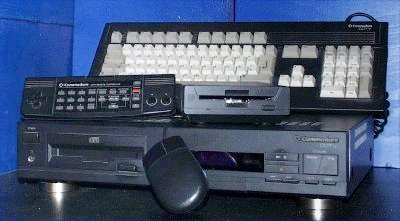
The heyday of the CD probably came in the 1990s, when players had moved out of the realm of the wealthy audiophile and into the cheap consumer electronics stores. A portable CD player could be had for a very affordable sum, and they began to oust the Walkman-style cassette player as the choice for music on the go. Meanwhile the CD-ROM followed a similar path to affordability, and no mid-1990s beige-box PC was complete without a CD-ROM drive and a multimedia encyclopedia. There were other CD-based appliances, multimedia appliances such as Philips’ CD-i and Commodore’s CDTV Amiga in a black box , Video CDs, and of course a crop of CD-based game consoles. The CD was largely responsible for the huge success of Sony’s first-generation PlayStation, while cartridge-based consoles had required developers to pay up front for a vast inventory of cartridges that might have become landfill if the product flopped, PlayStation developers merely had to pay for the CDs produced.
While the gaming public were going crazy about their PlayStations and listening to drum-n-bass on their Discmans, the writing was on the wall for the CD format. In 1998 the MPMan MP3 player made its debut, quickly followed by the first Diamond Rio, then a host of other players. The accompanying growth of file-sharing services such as Napster prompted a self-destructive legal meltdown from record companies and bands who turned on their own customers and fans in an effort to protect their CD sales, instantly making an MP3 file from the internet a far cooler choice than a CD from a corporate legal bully. The arrival of Apple’s iPod brought both an easy legal online music store and the MP3 player as a desirable lifestyle accessory, and the CD began its decline. It’s ironic in 2019 that the standalone MP3 player has experienced a steeper nosedive in the face of streaming services than the CD did, while the vinyl LP somehow always maintained a diehard following and has managed a resurgence (PDF) as it is rediscovered by a new generation.