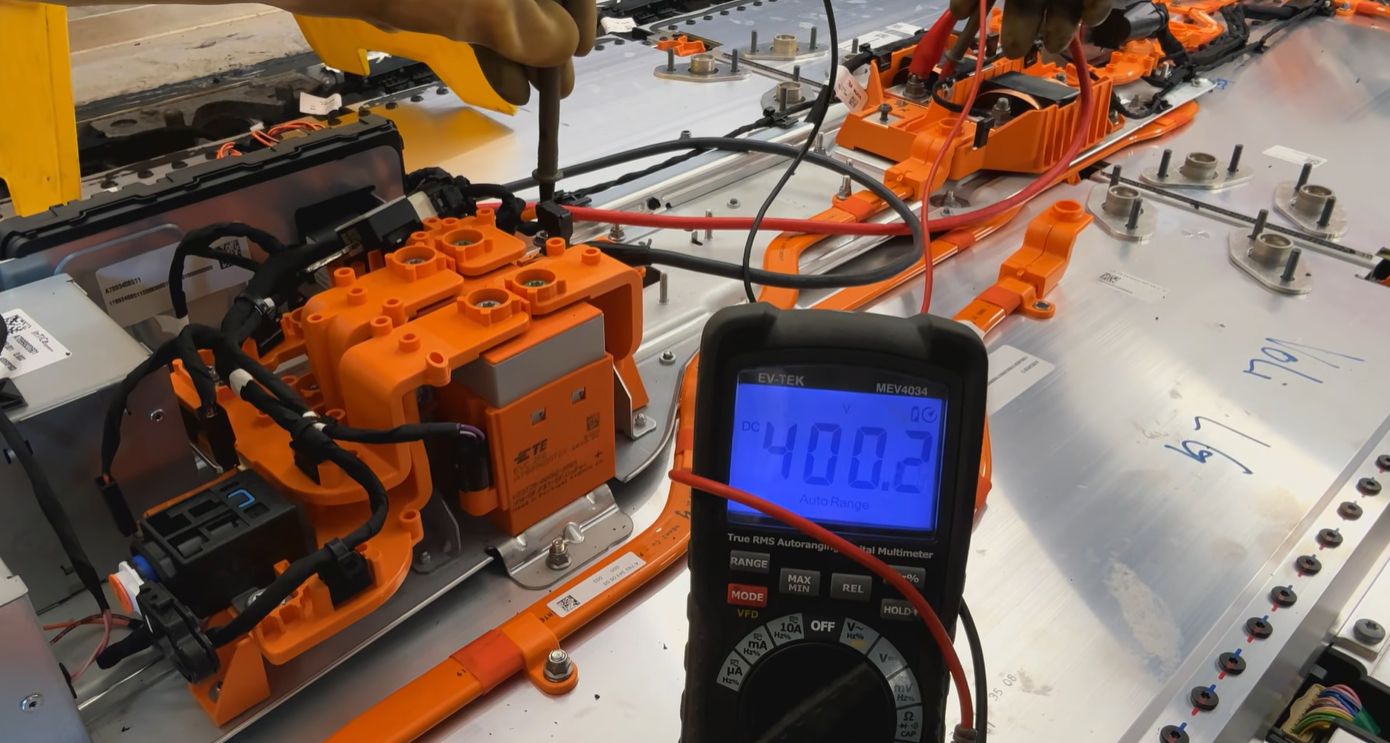
When [OGS Mechanics] got a Mercedes EQC 300 battery-electric car in for repair, it was found to have a bit of a weird issue: after sitting in a garage for a while, its range on battery had suddenly reduced significantly without clear cause. Although the typical response here is to just mark the battery pack as ‘faulty’ and replace the whole unit, [OGS] decided to dig into the pack to see what was going on.
The short version is that this particular battery pack consists of two individual batteries, each with its own BMS, one of which had reported a condition to the master BMS that triggered the ‘replace battery module’ error observed with the scan tool. From this it could also be seen that the first battery was at a 10% state-of-charge (SoC), and the second at 95%, making them incredibly unbalanced. Unfortunately the dealer procedure to rebalance did not work here, with only the second battery wanting to charge even after draining both to the same initial level.
To diagnose the underlying issue in earnest required gently prying open the battery pack like a massive glued-shut smartphone. Going by the theory that it is a software glitch, since the first battery was still at a healthy voltage level, it was decided to manually charge it. With both batteries now fully charged, the BMS for the first battery was then removed to have its memory overwritten with that of a known good BMS module, clearing the ‘replace battery module’ error.
Although in the preview for the next video it’s hinted that there’s also an internal balancing issue in the first battery pack, this could be another symptom of its BMS glitching out. Either way, it would seem that BEVs battery modules are both heavily dependent on software, as well as afflicted by the same throw-away culture that has people just buying a new smartphone when the battery fails.