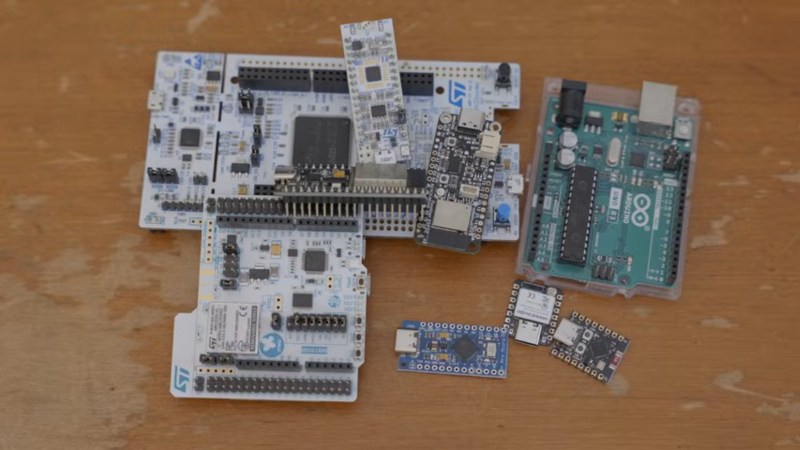
It’s fair to say that there are a lot of development board form factors for MCUs, with [Tech Dregs] over on yonder YouTube on the verge of adding another one to the pile, but not before he was having some serious thoughts on the implications of such a decision. Does this world really need another devboard with the ubiquitous 2.54 mm (0.1″) pitch pin headers, all so that it can perhaps be used in the same traditional 2.54 mm pitch breadboards?
The thought that [Tech Dregs] is playing with is to go for something more akin to the system-on-module (SoM) approach that’s reminiscent of the Raspberry Pi compute module form factor. This means using a 1 mm pitch for the headers and castellated edges in case you want use it as an SMT part, while breaking out many more pins of the onboard ESP32 module in far less space.
Obviously, the main advantage of this approach is that much like with compute modules you can leave most of the tedious cheap stuff on a carrier board, while the expensive to manufacture components are on a self-contained module. Meanwhile with the much finer pitch on the SoM contacts it’d straddle the divide between a 2.54 mm breadboard-capable devboard and a fully custom PCB, while making any mistakes on the carrier board much cheaper to redo.
The counterpoint here is of course that something like an ESP32 module is already a module with a finer pitch, but if you need more than just what it offers, or you want to use an STM32 or RP MCU across boards it could make a lot of sense.
Having 1 mm pitch breadboards would honestly also be rather nifty, natch. That said, what are your thoughts on this matter?