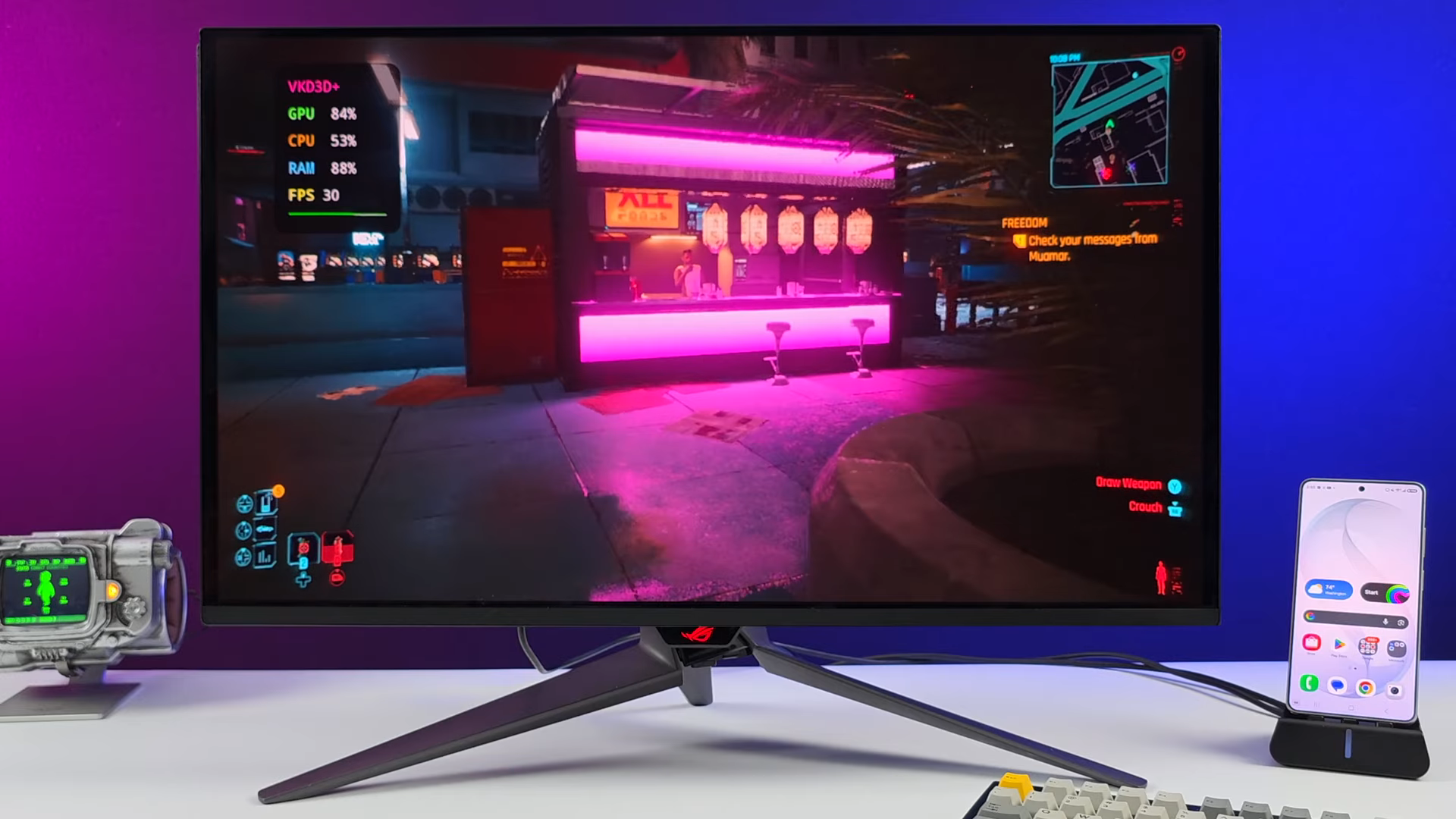
There was an ideal of convergence, a long time ago, when one device would be all you need, digitally speaking. [ETA Prime] on YouTube seems to think we’ve reached that point, and his recent video about the Samsung S26 Ultra makes a good case for it. Part of that is software: Samsung’s DeX is a huge enabler for this use case. Part of that his hardware: the S26 Ultra, as the upcoming latest-and-greatest flagship phone, has absurd stats and a price tag to match.
First, it’s got 12 GB of that unobtanium once called “RAM”. It’s got an 8-core ARM processor in its Snapdragon Elite SOC, with the two performance cores clocked at 4.74 GHz — which isn’t a world record, but it’s pretty snappy. The other six cores aren’t just doddling along at 3.62 GHz. Except for the very youngest of our readers, you probably remember a time when the world’s greatest supercomputers had as much computing power as this phone.
So it should be no suprise that when [ETA Prime] plugs it into a monitor (using USB-C, natch) he’s able to do all the usual computational tasks without trouble. A big part of that is the desktop mode Samsung phones have had for a while now; we’ve seen hackers make use of it in years gone by. It’s still Android, but Android with a desktop-and-windows interface.
What are the hard tasks? Well, there’s photo and video editing, which the hardware can handle. Though [ETA] notes that it’s held back a bit because Adobe doesn’t offer their full suite on Android. But what’s really taxing for most of us is gaming. Android gaming? Well, obviously a flagship phone can handle anything in the play store.
It’s PC gaming that’s pretty impressive, considering the daisy chain of compatibility needed last time we looked at gaming on ARM. Cyberpunk 2077 gets frame rates near 60, but he needs to drop down to “low” graphics and 720p to do it. You may find that ample, or you may find it unplayable; there’s really no accounting for taste.
We might not always like carrying an everything device with us at all times, but there’s something to be said in not duplicating that functionality on your desk. Give it a couple of years when these things hit the used market at decent prices, and unless PC parts drop in price, convergence might start to seem like a great idea to those of us who aren’t big gamers and don’t need floppy drives.