On August 8th, an experimental nuclear device exploded at a military test facility in Nyonoksa, Russia. Thirty kilometers away, radiation levels in the city of Severodvinsk reportedly peaked at twenty times normal levels for the span of a few hours. Rumors began circulating about the severity of the event, and conflicting reports regarding forced evacuations of residents from nearby villages had some media outlets drawing comparisons with the Soviet Union’s handling of the Chernobyl disaster.
Today, there remain more questions than answers surrounding what happened at the Nyonoksa facility. It’s still unclear how many people were killed or injured in the explosion, or what the next steps are for the Russian government in terms of environmental cleanup at the coastal site. The exceptionally vague explanation given by state nuclear agency Rosatom saying that the explosion “occurred during the period of work related to the engineering and technical support of isotopic power sources in a liquid propulsion system”, has done little to assuage concerns.
The consensus of global intelligence agencies is that the test was likely part of Russia’s program to develop the 9M730 Burevestnik nuclear-powered cruise missile. Better known by its NATO designation SSC-X-9 Skyfall, the missile is said to offer virtually unlimited flight range and endurance. In theory the missile could remain airborne indefinitely, ready to divert to its intended target at a moment’s notice. An effectively unlimited range also means it could take whatever unpredictable or circuitous route necessary to best avoid the air defenses of the target nation. All while traveling at near-hypersonic speeds that make interception exceptionally difficult.
Such incredible claims might sound like saber rattling, or perhaps even something out of science fiction. But in reality, the basic technology for a nuclear-powered missile was developed and successfully tested nearly sixty years ago. Let’s take a look at this relic of the Cold War, and find out how Russia may be working to resolve some of the issues that lead to it being abandoned.
The Nuclear Ramjet
The obvious tactical advantages of an ultra-long range weapons delivery system led the United States to experiment with several nuclear propulsion systems in the decades after the Second World War. The goal of one of these programs, known as “Project Pluto”, was to develop an engine that would give an unmanned aircraft a range better than 100,000 miles (160,935 kilometers).
At the direction of Dr. Theodore Merkle, the Pluto project focused its research on the concept of a nuclear ramjet engine. On paper, it’s an ingeniously simple idea: run air through an unshielded nuclear reactor, and the resulting energy transfer causes the air to rapidly heat and expand. A nuclear ramjet requires no liquid fuel; as long as the reactor is producing sufficient heat, it will run indefinitely.
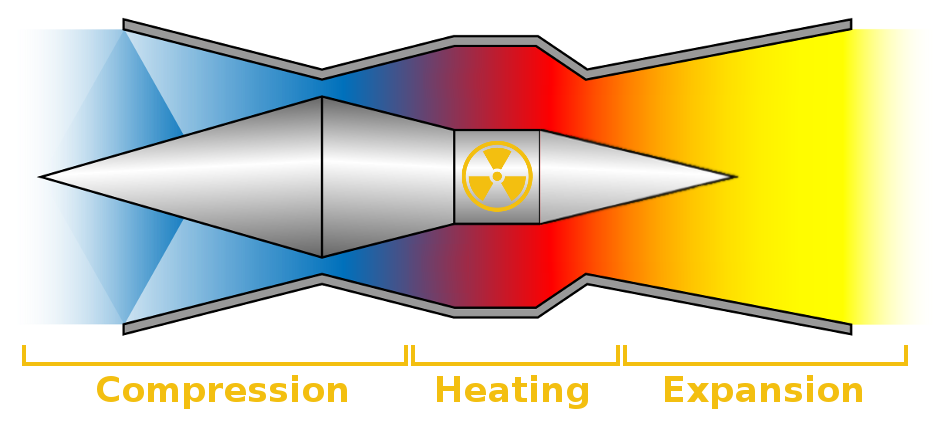
A nuclear ramjet still suffers from the same weakness of the traditional liquid-fueled version, namely the need to accelerate it up to around Mach 3 before the incoming air is compressed and pre-heated enough by the geometry of the intake for it to function. But with the addition of strap-on rocket boosters to get the vehicle up to speed, this wasn’t seen as a great engineering challenge at the dawn of the Space Age.
The larger problem was building a reactor core that was not only small and light enough to fit inside of the engine, but could also survive the intense heat required for the ramjet to function. The reactor would essentially be running in a continuous near-meltdown state, with only the flow of air to keep its internal structure cool enough to prevent it from tipping over the edge and spontaneously combusting.
Of course, this meant that slowing the aircraft down or stopping the engine was a dicey proposition. Once the engine was started, it was committed to just two possible outcomes: in peace it would crash (relatively harmlessly depending on how you look at it) into the ocean far from civilization, and if World War Three started, it would be plowed into an enemy target at full speed.
Unsafe at any Speed
Despite the obvious danger of developing and testing such an engine, Project Pluto actually produced two functional prototypes which were successfully run on the ground. The first engine, called Tory-IIA, was first fired on May 14th, 1961. It only ran for a few seconds, and was far too large to actually use for its intended purpose, but it proved the concept worked. Building on this success, a follow-up engine was constructed to flight-ready size and weight. That engine, Tory-IIC, ran for as long as five minutes during test runs in 1964. The nuclear ramjet was officially ready to fly.
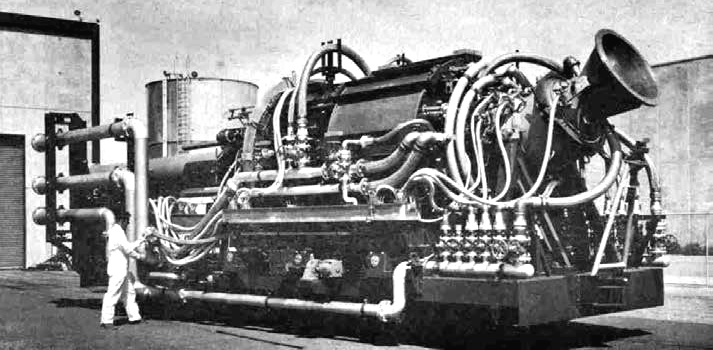
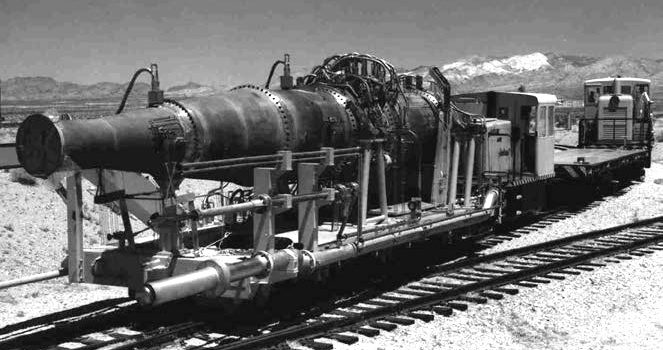
But as it turns out, the project never progressed past that point. While plans were well underway for the engine’s eventual first host, the Supersonic Low Altitude Missile (SLAM), concerns over the cost and practicality of the technology compared to Intercontinental Ballistic Missiles (ICBMs) lead to its cancelation shortly after testing Tory-IIC. At least, that was the official reason for ending research into nuclear ramjets.
Critics of the program argued that such an engine would not only be a danger to the crews launching it, but anyone who was under its flight path. Radiation emanating from the unshielded reactor was bad enough, but the nuclear ramjet would also spew fission fragments out in its exhaust while in flight. Even if its patrol area was limited to high latitudes within the Arctic Circle, it would still be uncomfortably close to friendly countries like Greenland and Canada.
In 1958, while Tory-IIA was still under construction, Dr. Merkle was called by the Joint Committee on Atomic Energy to testify about the status of Project Pluto. In questioning, he acknowledged what he believed was a manageable radiation risk for the ground crews who would prepare the engine for flight, and confirmed that they had detected fission products in the engine’s exhaust. But he said that even by his team’s most pessimistic estimates, the speed and altitude at which a nuclear ramjet aircraft would operate meant that little radiation would actually reach the ground. He could not, however, guarantee safety should the vehicle crash.
Modern Evolution
With this context, we can see there’s a glaring issue with the theory that Russia was testing a nuclear ramjet at Nyonoksa. The Rosatom statement specifically mentions “liquid propulsion”, which is at odds with what we know about the research conducted during Project Pluto. More to the point, there’s no way an engine that consumed a liquid propellant could deliver on the promised range and endurance goals of a nuclear engine. So what exactly were they working on?
Ignoring for the moment the possibility that the official statement was intentionally misleading or potentially mistranslated, the mention of liquid propulsion could be a hint that Russian engineers are attempting to address the most critical problems of the classical nuclear ramjet with the addition of liquid cooling. In this scenario, rather than the reactor being physically located inside of the engine itself, it’s connected via a closed-loop heat exchanger filled with a substance that will remain liquid even at extreme temperatures such as molten salt or metal.
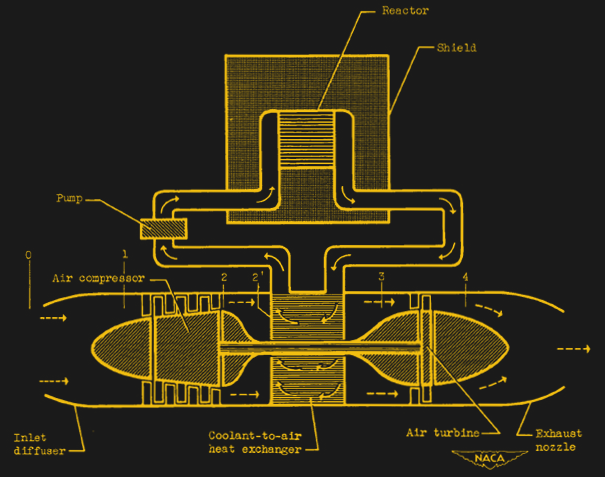
The United States experimented with this idea, known as the “Indirect Air Cycle”, during the Aircraft Nuclear Propulsion (ANP) program. Run from 1946 up until 1961, the ANP was eventually canceled by President Kennedy for ostensibly the same reasons Project Pluto was shelved: immense cost and complexity when compared to ICBMs. While the program never produced a practical aircraft engine, it did lead to the creation of the world’s first operational molten salt reactor (MSR).
Outfitting a nuclear ramjet with a molten salt or metal cooling system would allow heat to be transferred to the engine from a shielded reactor. This would not only make the system safer for the crews handling and launching it, but would remove the risk of fission products being released in the exhaust as air would not travel through the core itself.
In theory, it could also allow for deeper throttle capability and a safe shutdown procedure, assuming the liquid coolant could be redirected to external radiators to help control core temperature at lower airspeeds. Of course, the downside is that such an engine would be vastly more complex. But it also may mean the difference between a historical curiosity and a viable propulsion system.
Theories and Speculation
When he acknowledged its existence last year, Russian President Vladimir Putin said that development of the Skyfall missile was already far enough along that some early test flights had been completed. With rumors that the weapon could become fully operational by the mid-2020s to coincide with the deployment of the Avangard hypersonic glide vehicle, it would seem a reasonable assumption that its propulsion system would be undergoing active testing. But in reality, nobody outside the Kremlin truly knows what happened at the Nyonoksa facility on August 8th; and if history is any indication, we may never get the whole story.
It’s possible they were testing some evolved version of the nuclear ramjet, but it’s also possible the blast involved Poseidon, the nuclear-powered torpedo that Russia has been developing since 2015. Some have even theorized that the incident involved a next-generation radioisotope thermoelectric generator (RTG), a small nuclear power source designed for deep space probes and rovers.
For now, all we know is that engineers have lost their lives, citizens are at risk of being driven from their homes due to radioactive material being released, and the Russian government is not being forthcoming with information about what’s really happened. Even if the technology itself is cutting edge, its development certainly exhibits all the worst hallmarks of Cold War era politics.