Given the sheer volume of science going on as the International Space Station circles above our heads every 90 minutes or so, it would be hard for any one experiment to stand out. ISS expeditions conduct experiments on everything from space medicine to astrophysics and beyond, and the instruments needed to do the science have been slowly accreting over the years. There’s so much stuff up there that almost everywhere you turn there’s a box or pallet stuck down with hook-and-loop fasteners or bolted to some bulkhead, each one of them doing something interesting.
The science on the ISS isn’t contained completely within the hull, of course. The outside of the station fairly bristles with science, with packages nestled in among the solar panels and other infrastructure needed to run the spacecraft. Peering off into space and swiveling around to track targets is an instrument with the friendly name NICER, for “Neutron Star Interior Composition Explorer.” What it does and how it does it is interesting stuff, and what it’s learning about the mysteries of neutron stars could end up having practical uses as humanity pushes out into the solar system and beyond.
Of Neutron Stars and Pulsars
Of all the oddities out there in the universe, neutron stars surely number among the very oddest. A neutron star is the burnt-out core of a giant star whose outer layers have been blasted away in a cataclysmic supernova. Laid bare and immensely compressed by its own gravitation, the core retains all the original star’s angular momentum and so spins incredibly fast, up to 43,000 RPM, translating to a surface speed of nearly one-quarter the speed of light.
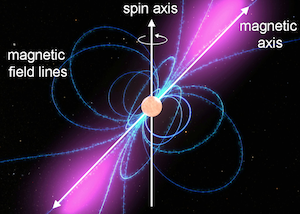
Pretty pictures are hardly the point of NICER’s mission. By carefully recording the spectrum and timing of X-ray signals from known pulsars, NICER will provide the raw data astrophysicists need to determine the true nature of neutron stars. Measuring small frequency variations in pulsar signals will even allow for asteroseismology, perhaps finally revealing what happens inside an object with the mass of two suns crushed into something the size of a small city. And coupled with other instruments, like the Modulated X-Ray Source mounted at the other end of the ISS, NICER is helping to develop high-bandwidth X-ray communications for future deep space exploration. Nice!
[Featured images: NASA]