Engineers are, for the time being, only human. This applies even more so to executives, and all the other people that make up a modern organisation. Naturally, mistakes are made. Some are minor, while others are less so. It’s common knowledge that problems are best dealt with swift and early, and yet so often they are ignored in the hopes that they’ll go away.
You might have heard the name Takata in the news over the last few years. If that name doesn’t ring a bell you’ve likely heard that there was a major recall of airbag-equipped vehicles lately. The story behind it is one of a single decision leading to multiple deaths, scores of injuries, a $1 billion fine, and the collapse of a formerly massive automotive supplier.
Cost Savings Led to Airbag Failure, Injury, and Loss of Life
Takata Corporation began manufacturing airbags in 1988, initially using sodium azide as the propellant. This was difficult to handle safely, and so in the 1990s, production switched to tetrazole, a safer alternative. However, this came at a high price, so research was undertaken to find an alternative.
Takata made the decision to switch to using ammonium nitrate as a propellant. Prone to breaking down under hot and humid conditions, it can become unstable, leading to airbag modules exploding rather than safely inflating in a crash. In these cases, the airbag igniter case can rupture, spraying metal fragments throughout the vehicle. This can lead to serious injury or even death for occupants of the vehicle.
The properties of ammonium nitrate were well known; other airbag manufacturers had long ruled out its use due to its stability issues. Engineers warned in the late 1990s that the material was unsafe for the application, long before the parts in question were installed in vehicles. In spite of this, Takata forged ahead, winning contracts with major automakers. As the years went on, millions of airbags with ammonium nitrate propellant would be installed in vehicles worldwide, and the timebombs began ticking.
Event Zero Was Just The Beginning
The first rupture of a Takata airbag was in May 2004, occurring in a 2002 model year vehicle in Alabama. According to the 2016 NHTSA report, Takata was first notified of the event in 2005. A month later, a Takata engineer presented their conclusions based on the limited data available to them.
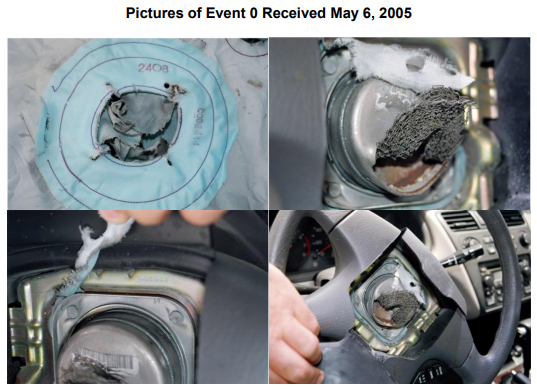
Based on photos of the aftermath, there was significant rust inside the inflator, which appeared to be present prior to the airbag firing. The cause of the problem appeared to be due to overpressure caused by the propellant, rather than substandard strength in the inflator casing material. After further research, Takata concluded the problem was likely due to improper sealing on the airbag components, and further action was not taken.
It would not be until 2007 that Takata learned of further dangerous airbag failures. By this time, millions more airbags had been installed in cars worldwide that included the dangerous inflators. Takata increased its research into the defects, searching for the root cause of the problem. This included a focus on investigating propellant density, as well as exploring whether there was a problem with poor seals on airbag components. In August 2009, the company had still not found a concrete cause of the fault, and enlisted the assistance of two independent outside companies, Fraunhofer and BakerRisk, to investigate the problem.
The investigation continued to go in circles for years. New failure events continued to crop up, with airbags from production lots outside the initial batches found to have problems. Key to the investigation was the “Stokes” press, which was suspected of producing low-density inflator materials which were more likely to cause ruptures. Engineers chased their tails trying to determine which airbags were produced on which press. Production lot numbers proved to be an unreliable record of which airbags were produced on which equipment, frustrating efforts to determine the cause of the problem.
Years went by, with teams investigating all manner of leads. In 2013, Takata were notified of the first case of an inflator failure from a batch manufactured outside the initial 2000-2002 period of interest. These were referred to as “Beta” failures, and began to highlight the broader issue at play. Fraunhofer’s continuing research began to show that instead of manufacturing issues, the problem was most likely caused by moisture and temperature cycling. At this point, the number of affected cars began to spiral out of control, as it became clear that few-to-none of Takata’s ammonium nitrate inflators were safe in the long term.
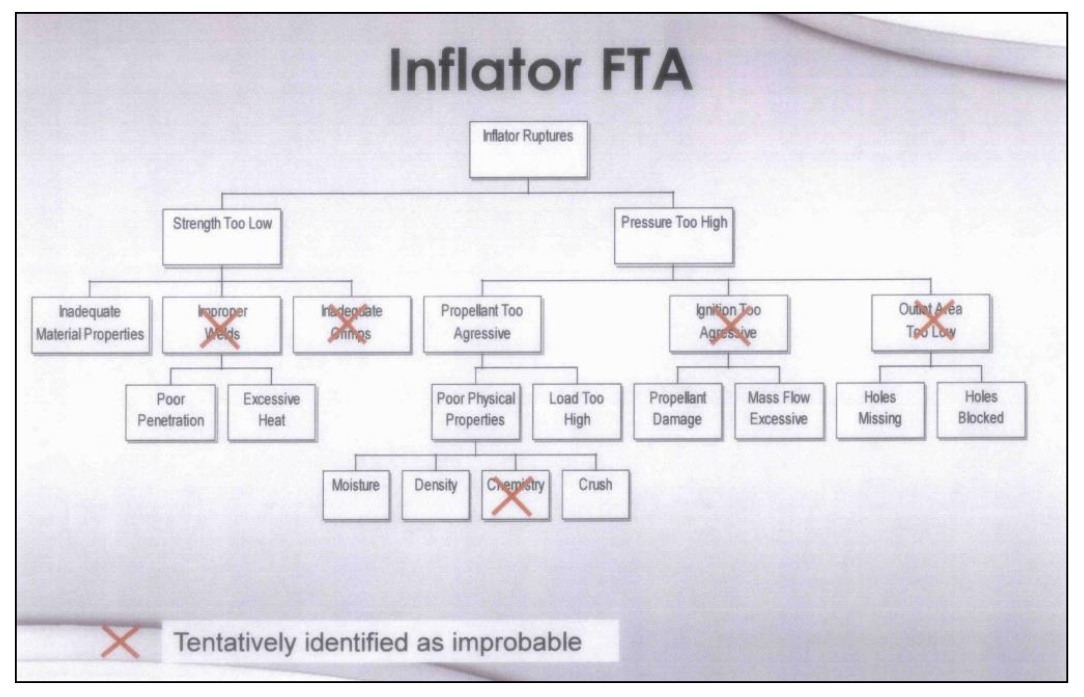
Early fault tree analysis from Takata shows that engineers were quick to rule out chemistry issues with their product. Instead, there was a strong focus on finding a manufacturing variability issue instead. While the investigation took its course, Takata factories continued to pump out ammonium nitrate inflators in their millions. This compounded the issue, as each new car sold with defective airbags would later become subject to a recall, requiring parts to be replaced.
A Two-Pronged Problem
Identifying the root cause of the issue was just the first, and easiest, step of the process. To solve the problem once and for all, millions upon millions of cars, from a huge number of manufacturers, would need to have their airbags replaced. The effort required to achieve this is truly Herculean in scope, and it has been far from smooth sailing thus far.
For cars with a single owner from new, it is a relatively simple task for dealers to contact the owner and send out a recall notice. However, with cars sold on the used market, records are poor to non-existent. Trying to educate the entire car-owning public that their car may be packing a dangerous explosive device is a difficult and expensive task. Car companies have taken out advertisements in newspapers, at stadiums, and gone so far as hiring private detectives to track down owners. Websites and other services have been created in various countries to allow motorists to check their Vehicle Identification Numbers against databases of recalled vehicles. Despite this effort, and the fact that recalls have been ongoing since 2008, the message isn’t always getting through. And that’s only half the problem.
Parts Were Slow to Materialize for Recall Service
It’s one thing to know that your car could potentially have a defective and dangerous airbag installed. It’s another thing entirely to get the problem rectified. Parts availability has been a continual problem during the recall process. Owners have been told that they will be notified to bring their car in “when parts are available”, and told to avoid using the front seats in the meantime. Obviously, this is of cold comfort to drivers who rely on their cars for transport on a daily basis.
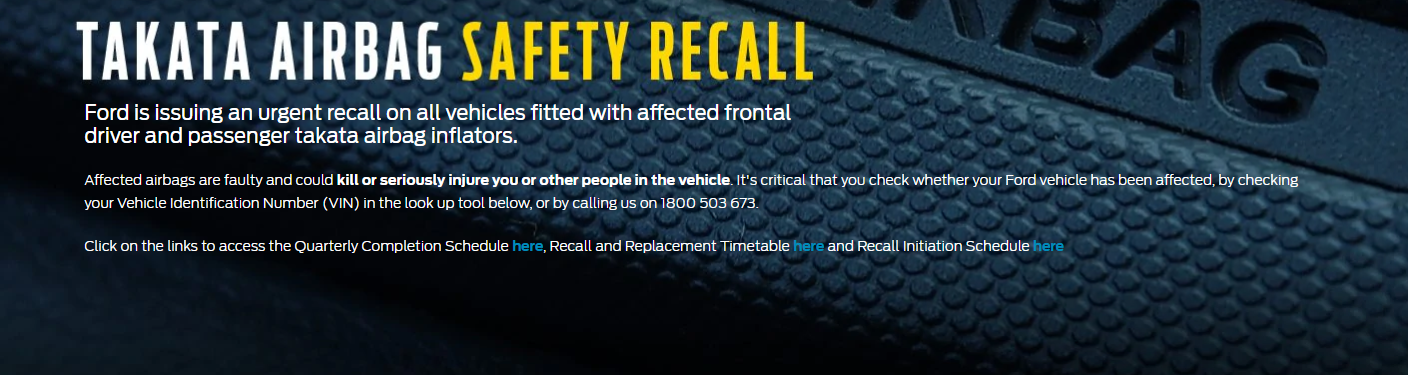
The unprecedented volume and scope of the industrywide Takata airbag inflator recalls have created unique replacement parts challenges for all vehicle manufacturers and global parts suppliers. At NHTSA’s request, Ford issued safety recalls for vehicles with certain Takata inflators even though replacement inflators with a different propellant would not be available for months or even years; in the meantime, new inflators are being redesigned and manufactured.
-Statement from Ford Motor Company, 2018
Given that cars were produced with defective inflators for well over a decade, it’s not a problem that has an easy fix. Airbag manufacturing is a niche industry, and production capacity exists to serve the demand for new vehicle production each year, and to maintain spare parts inventory. It simply isn’t possible to produce several years worth of new airbags for older vehicles overnight. This leaves many drivers with a difficult decision to make — to hope that their airbag is safe, or acquire another vehicle, often at their own expense.
This Isn’t a Small Fix
Unfortunately for Takata, and millions of drivers around the world, the problem wasn’t a short-lived manufacturing error. The choice to use ammonium nitrate was a fundamental design flaw, meaning entire product lines were affected. This meant that the problem wasn’t as simple as correcting a production line error, and cranking out more parts. Airbags for hundreds of different models would have to be redesigned, tested, and put into production.
Ford is currently engaged in the complex and lengthy process of developing replacement nonammonium nitrate-based airbag inflators from alternative suppliers. Airbag inflators are highly engineered and unique to each model and model year. In addition to the lengthy design and revalidation process, the scarcity of global production capacity from inflator suppliers is contributing to a delay in global replacement parts availability.
-Statement from Ford Motor Company, 2018
Unsurprisingly, this caused headaches, if not migraines, for automotive companies the world over. Focus was placed on replacing parts in older cars first, in areas with high heat and humidity. The airbag industry is highly concentrated, however AutoLiv, TRW, and Daicel have stepped up to the plate, devoting their own resources to the effort to get replacement parts out in the field.
For many people, the fix still hasn’t come fast enough. As recently as 2016, vehicles were still being sold with defective inflators, with automakers admitting that these would have to be recalled by 2018. With the Takata airbags becoming more dangerous over time, the thinking is that these cars would likely be safe enough while resources are devoted to fixing riskier older vehicles. Owners of cars from certain manufacturers have been lucky enough to receive loan cars, while others continue to drive around, in the hopes that nothing goes wrong.
The Fallout
In 2016, Bloomberg reported over 13 people had died, and 100 had been injured, due to the defective Takata inflators. By 2017, Takata had filed for bankruptcy, with the cost of the recall and related liabilities exceeding $10 billion. The company was bought out by Key Safety Systems, with the aim being to keep the factories open and churning out replacement airbags with as minimal disruption as possible.
Millions of cars remain unrepaired in the US, with similarly worrying numbers elsewhere. Parts shortages continue to frustrate the repair effort, and many owners remain unaware of the dangers lurking behind their dashboard. Deaths continue to stack up, with the most recent case being a 2002 Honda Civic claiming the life of an Arizona man in June 2018. The vehicle in question had been under recall for over 3 years, with no repairs undertaken in that time.
Hindsight Is A Wonderful Thing
Producing airbag inflators with a dangerous propellant was a mistake, and one that would have dire consequences. However, the bigger mistake was ignoring the problem at every turn when it came to light. Thanks to the dedicated efforts of Takata to avoid facing the problem early on, millions more cars would ship with defective parts, and many more drivers and passengers would be placed in danger. This further complicated the efforts required to solve the issue.
Industry bodies and automakers continue to find themselves trapped between a rock and a hard place — trying to get the word out to customers, while simultaneously tell them they must wait until replacement parts are available. It’s a painful communication problem with no easy solution. The major lesson going forward would be to stamp out spot fires before they become raging, uncontrollable conflagrations that threaten lives the world over. With Takata only pleading guilty in 2017, it’s clear that the problem could have been avoided entirely if early warnings had been heeded. It’s rare that a single engineering decision can lead to such a quagmire of pain and misery, but in concentrated industries with few suppliers, the stakes can be much higher.
Going Forward
The Takata airbag debacle will be an example case taught in business and engineering classes for decades to come. The very earliest warnings were ignored, and by the time the real problem became apparent 15 years later, the damage was already done. The biggest automotive recall in history is still in progress, and the after effects will likely be felt for some time yet. In the meantime, check your own vehicle, and advise your friends and family to do the same. And, as ever, if you’re warned by an engineer that you’re making the wrong decision, it might just pay to listen, in both dollars and lives.