It should come as no surprise that we here at Hackaday are big boosters of autonomous systems like self-driving vehicles. That’s not to say we’re without a healthy degree of skepticism, and indeed, the whole point of the “Automate the Freight” series is that economic forces will create powerful incentives for companies to build out automated delivery systems before they can afford to capitalize on demand for self-driving passenger vehicles. There’s a path to the glorious day when you can (safely) nap on the way to work, but that path will be paved by shipping and logistics companies with far deeper pockets than the average commuter.
So it was with some interest that we saw a flurry of announcements in the popular press recently regarding automated deliveries. Each by itself wouldn’t be worthy of much attention; companies are always maneuvering to be seen as ahead of the curve on coming trends, and often show off glitzy, over-produced videos and well-crafted press releases as a low-effort way to position themselves as well as to test markets. But seeing three announcements at one time was unusual, and may point to a general feeling by manufacturers that automated deliveries are just around the corner. Plus, each story highlighted advancements in areas specifically covered by “Automate the Freight” articles, so it seemed like a perfect time to review them and perhaps toot our own horn a bit.
We Deliver for You
On any short list of most maligned public-sector institutions in the United States, the Postal Service would probably make an appearance. Sadly, a lot of the damage is self-inflicted by a damaged bureaucracy, but in general, the men and women of the USPS do good work, and those that bad-mouth the Postal Service would do well to remember that providing universal delivery in a country the size of the United States is not exactly an easy job.
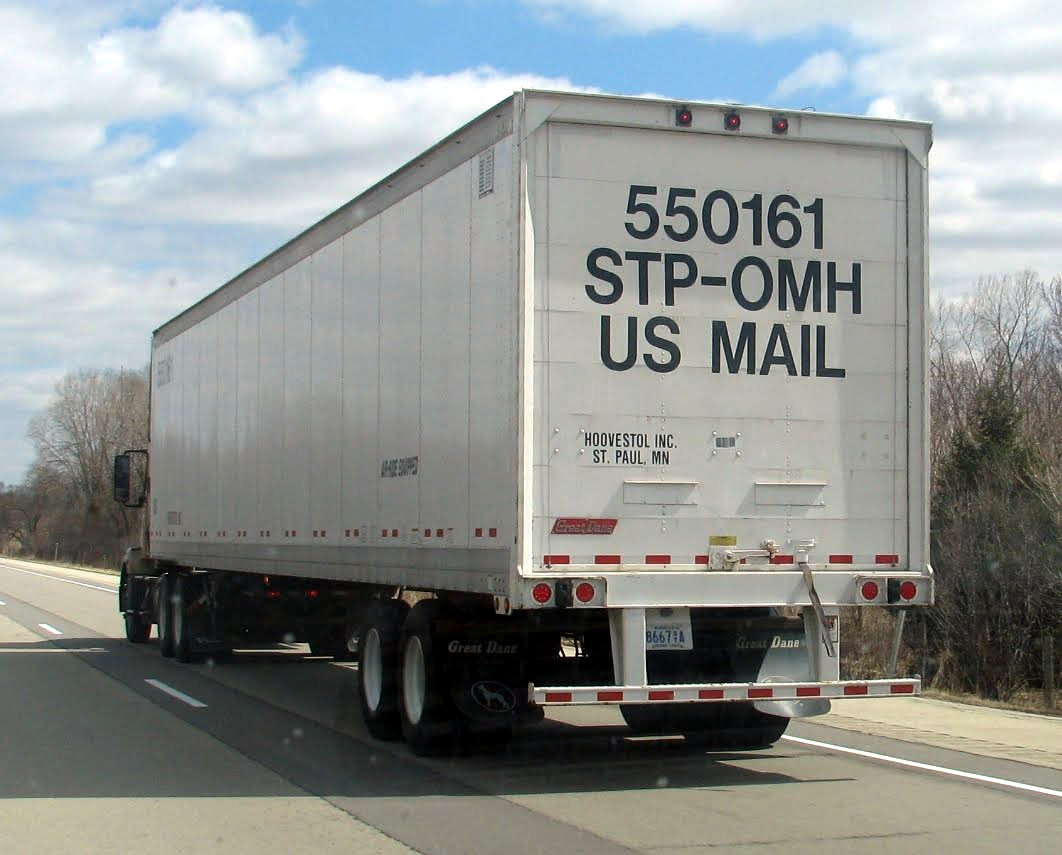
Semi trucks carrying tons of bulk mail between gargantuan national distribution centers and smaller regional facilities are what form the backbone of the continent-wide postal network. These trucks are common sights on Interstate highways in the US, running fixed routes back and forth on a schedule as regular as clockwork. If a pilot program by the USPS bears fruit, those trucks may soon be driverless.
According to Reuters, the USPS has teamed up with self-driving truck startup TuSimple to test self-driving trucks on the bulk-mail route between Phoenix and Dallas this month. The truck, with a safety driver and an engineer on board, will make the 2,000-mile (3200-km) round trip five times. Under normal conditions, the trip takes 45 hours to complete, which requires the use of team drivers. Paying one driver to drive while the other sleeps gets expensive, and with a shortage of drivers in the US it’s often hard to staff. The route is the perfect test bed, too — long, lonely stretches of highway with good visibility, and plenty of services along the way.
It will be interesting to see what becomes of this experiment, and how far it goes in terms of completely replacing long-haul drivers. TuSimple claims to have depot-to-depot capability, unlike some self-driving truck companies that only go driverless for the highway part of the route and let carbon-based drivers handle the surface streets. The video below is pretty convincing on that score — in foul weather, no less — and if they eventually start operating without safety drivers, the USPS and others might start to see some real benefits from autonomous trucking.
Close Air Support
Amazon made a big splash a few years back with some wildly optimistic plans for same-hour delivery of orders via drone. Much fun was poked at the company for its glitzy videos and contrived delivery scenarios, for the seemingly endless variety of UAVs they were willing to throw at the problem, and for patenting silly things like a shipping label that turns into a parachute.
But it seems like Amazon and others with a vested interest in speedy deliveries might have the last laugh. Deutsche Post DHL, the world’s largest logistics company, has begun its first regular UAV delivery service in an urban setting. The Chinese city of Dongguan in Guangdong province is the scene of the somewhat limited test, on a delivery route created especially for a DHL customer. The two facilities are only 8 km (5 miles) apart, but urban traffic and winding roads make that a 40 minute trip by delivery truck. The UAV, an EHang Falcon commercial drone in DHL livery, takes off from an automated hangar that looks a little like a pop-top shipping container. It flies autonomously between the two facilities in only eight minutes.
Again, this is a contrived route for a limited service, but full points to DHL for getting this far. Autonomous drone deliveries over populations and beyond line-of-sight of a safety pilot are probably still a long way off in the US and Europe, but when they get here, it’ll be because of what outfits like DHL learn with experiments like this.
Slow Walking It
Despite what Amazon may think, we doubt that UAV deliveries direct to residential consumers are ever likely to happen on a large scale. That means the “last 100-meter” problem will need to be tackled, to get packages from the back of a self-driving delivery van and to the customer’s door. It’s a thorny problem, and recent silly ideas aside, it hasn’t been tackled in a serious way yet.
That hasn’t stopped companies from trying, as the Ford Motor Company did recently with another fanciful video of Digit, the bipedal delivery robot. A product of Agility Robotics, Digit is a somewhat anthropomorphic robot, if you ignore legs bending the wrong way (and the whole decapitated thing). The idea is that Digit will ride in the back of a self-driving Ford van, stuffed with packages to drop off for waiting customers. When the vehicle arrives, Digit unfurls itself and navigates autonomously around obstacles to the door, package grasped between its stumpy arms.
The video is a little hard to swallow, and the faux fist bump at the end was just lame. But just like how automakers come up with silly concept cars that sometimes make it into production (looking at you, PT Cruiser), Digit or something like it could someday be a common sight in neighborhoods. Ford’s scenario looks quite similar to one we proposed a while back, although we still think the wheeled robot would be far more efficient for such a job.
One way or another, economic forces are going to push autonomous systems into the logistics chain. From picking and packing orders to moving them over the road and eventually dropping them off at our doors, people are going to disappear from deliveries in favor of robots. Dealing with the fallout from that will be a challenge, but it’s hard to see any other end to this story.