It’s true that I’m not known for keeping particularly regular hours, but even I had my doubts about this plan. We’d go to sleep around midnight, wake up at 3 AM, drive up the coast aimlessly, then turn around and attend a full-day event where we’d have to maintain at least some semblance of professionalism. It was a bad idea, terrible even. But there I was at 11:30 PM sitting in a Waffle House with Thomas, the Supplyframe videographer, getting dangerously close to signing off on it.
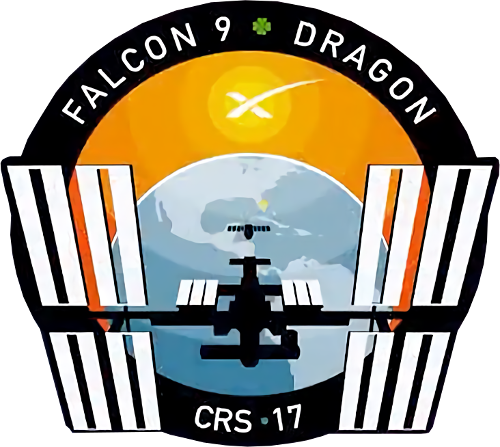 Officially we were there to cover the Cornell Cup Finals being held at Kennedy Space Center, but as it so happens, our arrival in Florida perfectly coincided with the launch of CRS-17, SpaceX’s latest International Space Station resupply mission. Technically this was not part of our assignment. But really, what choice did we have?
Even if our respective bosses didn’t see it as a wasted opportunity, we had to consider the locals. In the few hours we’d been here, it seemed the launch was all anyone wanted to talk about. Everyone from the airport shuttle driver to the waitress who brought us our hash browns reminded us a rocket would be lifting off soon. If we didn’t go, then come Friday afternoon we’d be the only people in Cape Canaveral who didn’t have a personal account of the event. By all indications, an unforgivable cultural faux pas in central Florida.
Of course, the truth of the matter is that we didn’t actually need any convincing to go on this adventure. We had the supreme good fortune of finding ourselves in the vicinity of Kennedy Space Center a few hours before they were going to send a rocket thundering off into the black, and there was no way we could just sleep through it. No, there was never any choice in the matter. We were going.
Friday 2:30 AM
When the alarm next to the bed went off, I was sure it was some kind of a mistake. When my phone went off a few minutes later, things started coming into focus. Professionalism, hash browns, rockets. The launch was scheduled for 3:11 AM, not much time.
Before fully committing to consciousness, I checked the weather on my phone. Last we’d heard, there was only a 40% chance that conditions would be clear enough to fly; and I’ll admit a not insubstantial part of me was hoping the storm that was threatening Cape Canaveral from offshore had decided to make a move inland while we slept. Instead, the SpaceX sleuths on reddit were reporting that weather was no longer a concern and launch preparations were already underway. Pants it is, then.
Thomas was already waiting in the lobby with his video gear when I got down there, removing any doubts I might have had about his commitment to this expedition. He was excited because a local had given him directions to a spot which supposedly would give us a clear line of sight to the launch pad. Those directions were vague; we just had to drive down this particular road for awhile until we see other cars, and then pull off onto the sand. It sounded a lot like the opening of Deliverance to me, but I didn’t have a better idea so we got into the car and started driving.
In hindsight, I’ve got to admit that the directions were spot on. As promised, after we crested the bridge over the Banana River, there was no missing the line of brake lights amassed on the small strip of marshy beach. We pulled off to the side of the road and Thomas started setting up his camera, adding to the line of softly glowing LCD displays that were already dotting the shoreline here.
With around fifteen minutes to go before liftoff, I pulled out my phone and started SpaceX’s live YouTube stream. Eyes alternating between my own softly glowing LCD and the launch pad on the horizon, my heart sank when I saw the timer on the screen halt at 13:54 and then jump back to 15:00.
Under normal circumstances, a delay of a few minutes wouldn’t be that big of a deal. But when the Falcon is headed towards the International Space Station, the actual moment of liftoff must be precisely timed down to the second so that the Dragon spacecraft can catch up with it.
Incidentally, I recall someone (possibly Elon Musk himself) once commenting that this isn’t entirely accurate, as the Falcon 9 and Dragon between them have enough propellant in reserve that they could compensate for a non-optimal liftoff. But it would involve plotting a new course at the last minute, which is one of those things that NASA doesn’t want to do, out of an overabundance of caution. Since they’re the ones footing the bill, we’re left with this so-called “instantaneous” launch window.
It would be a minute or two before the commentator on the YouTube stream officially declared the launch scrubbed, but I’d already told Thomas to pack up his gear when I saw the countdown timer glitch. We were pulling back on the road about the same time most of the people watching the launch realized what had happened. The next instantaneous launch window would be slightly less than 24 hours from now, and in the meantime, we had interviews to conduct.
Saturday 2:00 AM
There’s a line in the sand between staying up late and waking up very early, and apparently it’s right around three in the morning. The nuances of orbital mechanics meant the second launch attempt would happen at 2:48 AM, which somehow seemed a reasonable enough time that we didn’t bother trying to sleep beforehand. Combined with the fact that we already knew exactly where to go, we arrived at the beach with plenty of time to spare.
With the YouTube stream once again running in the background, we glued our eyes and viewfinders firmly on the spotlights in the distance. I expected a certain level of delay between the video stream and the actual event, so I reminded Thomas to start recording before the countdown hit T-10 seconds. As it turns out, the delay was closer to only a second or two, and provided us with near real-time commentary as we watched.
At almost 12 miles away from from the launch pad, seeing the rocket itself was essentially impossible. But it certainly wasn’t hard to see what was happening. When the nine Merlin engines ignited, the exhaust exiting the flame trench created a luminous cloud that expanded along the horizon. A few seconds later, moving slowly at first, the rocket rose above the exhaust cloud and clawed its way into the sky. The night suddenly appeared more like dusk, as the rapidly accelerating fireball cast an incredibly bright glow that reflected off the surface of the water in front of us.
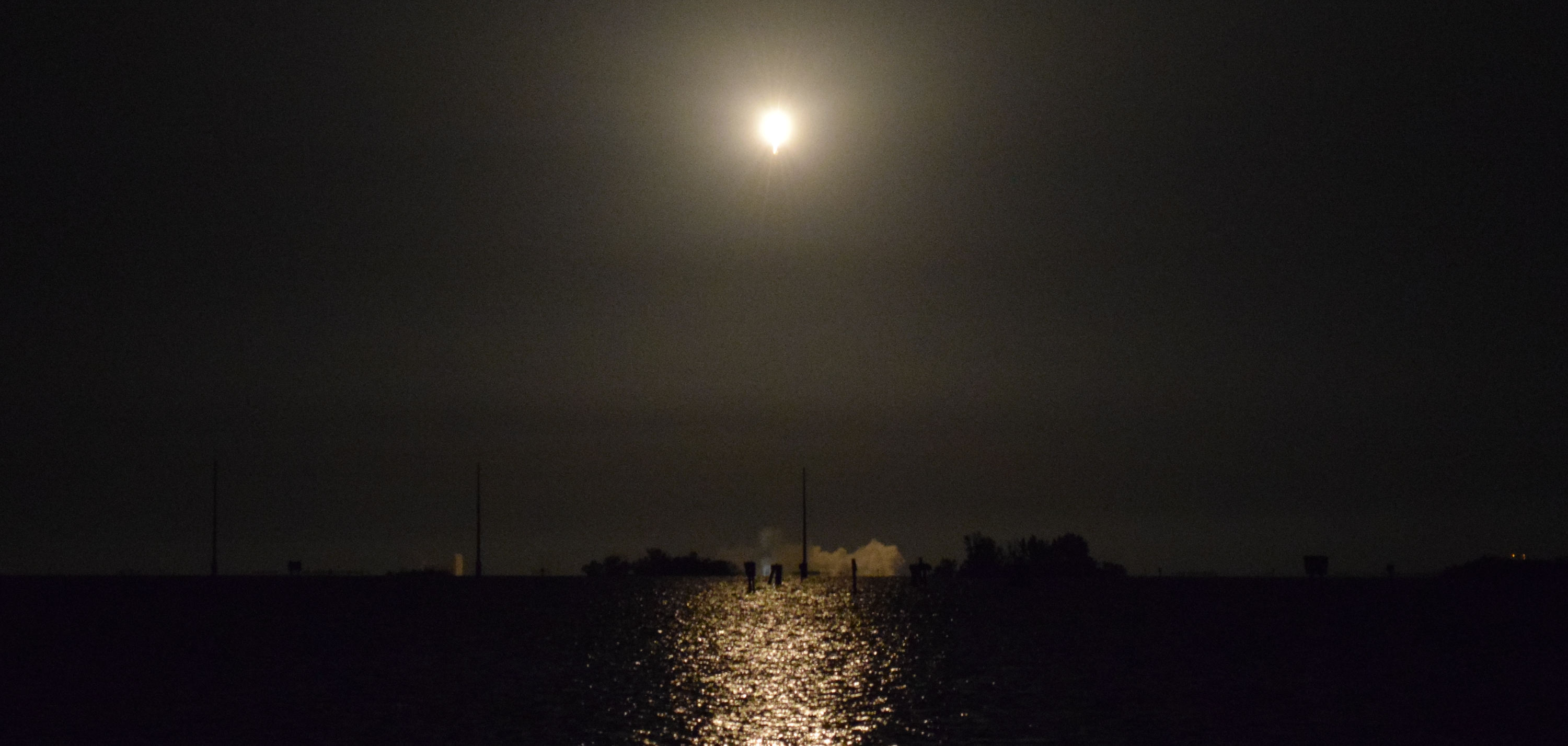
Up until this point, everything had happened in silence. At this range, it took a solid minute for the sound to reach our position. I’ve heard it said that the roar of the Space Shuttle was considerable even at this distance, but that certainly wasn’t my experience with the Falcon 9. The sound was more like the distant rumble of thunder, and only lasted for around 30 seconds before we were once again watching in silence.
The rocket was now climbing fast, and moving away from us. Rising through the atmosphere, it briefly left a glowing contrail in its wake. With the surrounding atmospheric pressure falling rapidly, the exhaust plume from the engines began to expand and become more transparent. I knew to expect this from watching my fair share of launch videos, but there in person, I was struck by the massive shimmering cloud trailing behind the craft. From my perspective, the gossamer ball of gas seemed as large as the Moon.
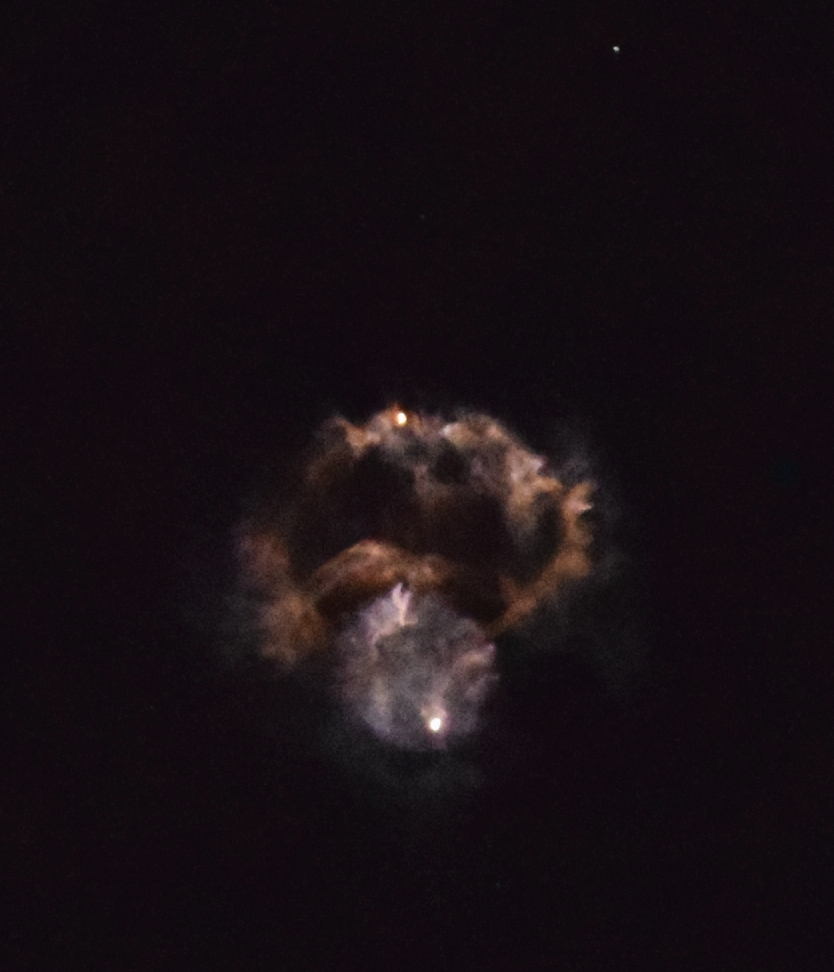
Suddenly, the cloud fractured and separated, and we could clearly see separate glowing objects moving away from each other. I feared the worst, and my mind instantly recalled the images of Space Shuttle Challenger as it exploded shortly after liftoff. But in a few seconds the narration on the live stream made it clear: we’d just witnessed stage separation. What was previously one vehicle traveling through the upper atmosphere was now two independent vehicles with their own trajectories and missions.
The flight path of the first stage had clearly made a radical change, as it flipped over and fired its engines against the direction of travel to lose some of its velocity. From the ground, it appeared to be moving vertically while the second stage continued to retreat away from us. Despite the live stream indicating an altitude of better than 150 kilometers at this point, the second stage could still clearly be seen as a fiery star in the sky.
Now, all attention turned to the first stage which would shortly be returning to Earth. It had been several minutes since it last lit its engines, and none of us were quite sure where to look. When it roared back to life, we were caught off guard; it seemed far closer and lower than we’d anticipated. As the rocket lowered itself onto a barge just off the Florida coast, it was like watching the launch in reverse.
From our vantage point we couldn’t see the moment of touch down, but we did receive a consolation prize. A few seconds after the live stream announced a successful landing on the drone ship Of Course I Still Love You to roaring applause, we experienced something you never get when watching a launch on YouTube: the thundering crack of double sonic booms that herald a large object tearing through the atmosphere. The Falcon was home.
Sunday 9:00 AM
With a cross-country trip ahead of him, Thomas left early on Sunday morning. But with only a two hour flight up the East Coast between me and home, I decided to explore the Space Coast for a bit longer; the fruits of which you’ll see on these pages soon. While I was eager to get back to Kennedy Space Center, there was a stop I needed to make first. During the night the landed first stage of the Falcon 9 had cruised into Port Canaveral aboard Of Course I Still Love You, and now in the light of day, it towered triumphantly over the tugboats and cargo ships drifting past.
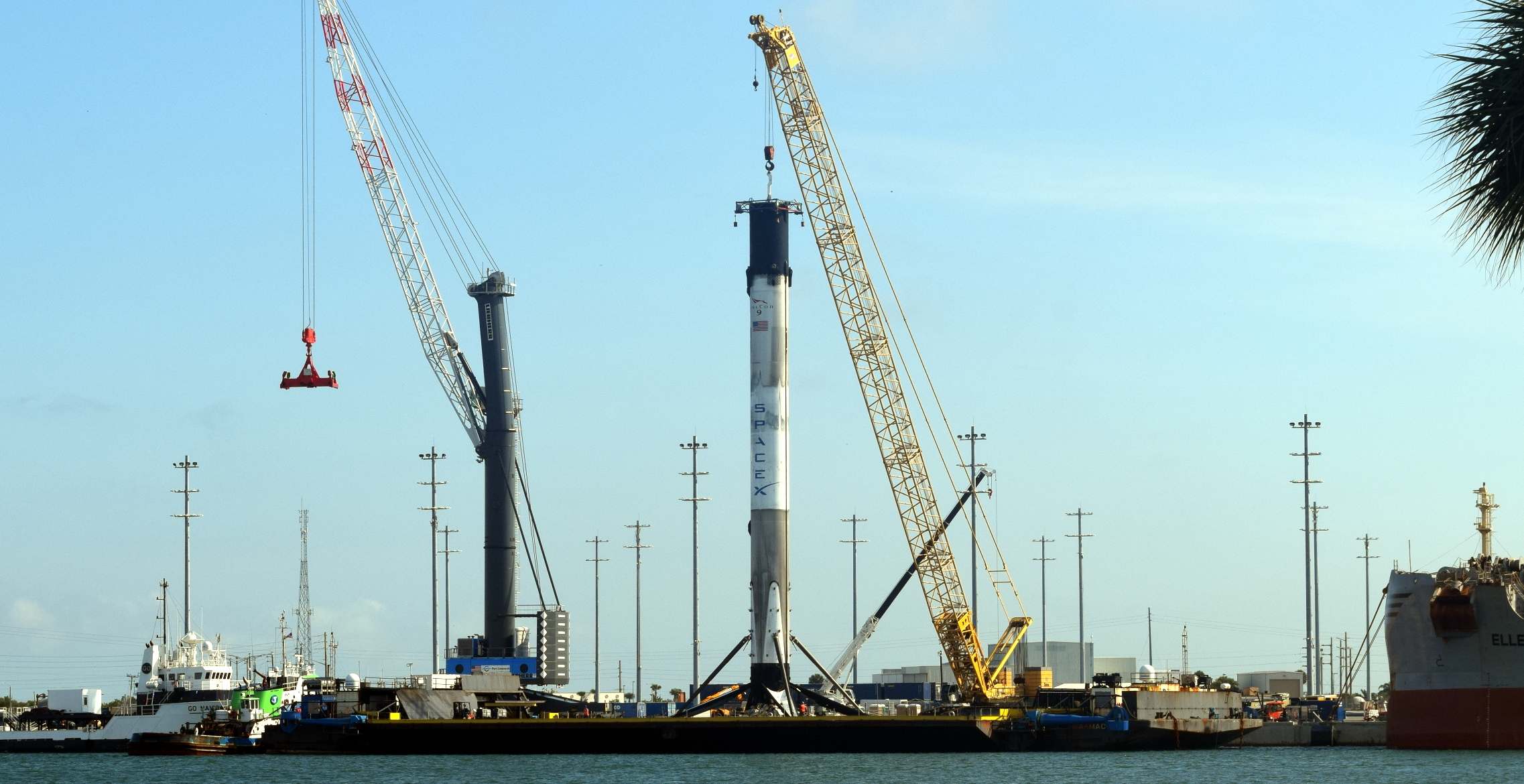
Standing before me was the very same rocket I’d spent the last 48 hours chasing through the Florida swampland. In a single weekend I experienced both the crushing disappointment of a scrubbed launch and the fire and fury of a successful one, but neither feeling quite compared to this. Seeing the workers flitting about its landing legs, I truly understood the sheer scale of what I’d watched from a distance. This vehicle, tall as a high-rise building, had just flown to space and back; and after some refurbishment, it’s going to do it again.
There are few moments in your life when you can honestly say you’re looking at history in the making, and for me, this was one of them. After watching it in action, there’s no longer a question in my mind that this is the shape of things to come; and I’m excited as hell to see where it goes from here.