The world’s largest aircraft is flying. Stratolaunch took to the skies in test flights leading up to its main mission to take rockets up to 20,000 feet on the first stage of their flight to space. But the Stratolaunch is a remarkable aircraft, a one-of-a-kind, and unlike anything ever built before. It can lift a massive 250 tons into the air, and it can bring it back down again.
By most measures that matter, the Stratolaunch is the largest aircraft ever flown. It has the largest wingspan of any aircraft, and it has the largest cargo capacity of any aircraft. In an industry that is grasping at interesting and novel approaches to spaceflight like rockoons and a small satellite launcher from a company whose CTO is still a junior in college, the Stratolaunch makes unexpected sense; this is a launch platform above the clouds, that can deliver a rocket to orbit, on time.
But the Stratolaunch is much more than that. This is an aircraft whose simple existence deserves respect. And, like others of its kind, the Antonov AN-225, the Spruce Goose, there is only one. Even if it never launches a rocket, the Stratolaunch will live on by the simple nature of its unique capabilities. But what are those capabilities? Is it possible for the Stratolaunch to serve as a cargo plane? The answer is more interesting than you think.
Cargo has always been the backbone of aviation. The first airlines weren’t interested in passengers, and air mail made up the bulk of a manifest. The venerable 747, the queen of the skies, wasn’t meant to be a passenger airliner, it was meant to haul cargo. It’s with cargo that aviation gets its most interesting accomplishments, and here history bears this point.
Containers of Cargo
The Fairchild C-119 was a military transport plane designed in the post-war period with an interesting mission. The sole purpose of this plane was to deliver cargo and the mechanized equipment of war in the modern era. A thousand or so were built, and they served the role well. However, in the years after the production of the C-119, a quite literal sea change occurred in the shipping industry. The rise of containerization happened. Instead of longshoreman unloading boats packed to the gills with wooden crates, container ships started to head into port. These ships, still seen at shipyards today, were designed to fit a standard 40-foot container. Load up a box at a factory, put it on a truck, drive to the port, load it onto a ship, and repeat the process backwards again in a few weeks. This is the modern reality of shipping, but aside from standard pallets in the decks of cargo aircraft, it never really happened in aviation.
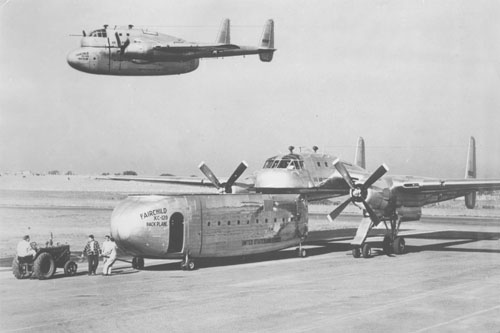
The XC-120 Packplane was the answer to containerization of the air. This was a standard C-119, highly modified to turn the entire cargo deck into a large container that would easily fit on a truck. The idea was solid, and one aircraft was built. This thing flew, but it just wasn’t considered practical. There’s no forward or backward-opening door on the XC-120 cargo pod, so rolling jeeps into the thing would be impossible. nevertheless, this is an idea that just keeps popping up in the aviation world every few years or so.
The Trick Isn’t Flying a Lot Of Cargo, It’s Flying Weird Cargo
Right now, the largest operating cargo aircraft on the planet is the Antonov AN-225. It’s enormous, and the cargo deck is longer than the Wright Brothers’ first flight. If you’ve ever wanted to see the inside of this gigantic airplane, the Points Guy has a much better job than me.
The AN-225 was built in the 80s for a specific purpose: to carry the space shuttle. The USSR’s Buran spacecraft was an improvement over NASA’s space shuttle orbiter, and if you build a space shuttle, you’re going to have to move it around. NASA solved this problem by modifying a 747. The Soviets solved this problem by building the largest aircraft ever.
The Buran program and the idea of Soviet supremacy dissolved, but this gigantic aircraft lived on. Antonov Airlines inherited the aircraft, and they did what anyone would do with an incredible, one-of-a-kind machine: they rented it out. Right now, if you need to move something big, now, you contract Antonov Airlines. They’re on call to move anything that would take too long to move by ship.
With the right design for a cargo pod, this is something the Stratolaunch could do very well. If cargo were simply shoved into a pod, just like the XC-120 Packplane, the Stratolaunch could carry heavy, difficult-to-transport, and time-sensitive cargo to destinations around the globe. This isn’t an aircraft explicitly designed to launch rockets, it’s just an airplane meant to carry huge cargo. Even without a single launch, the Stratolaunch could still be a viable aircraft in the oversize cargo market.
Of Course, Carrying Cargo To Space Still Counts
The entire point of the Stratolaunch is to carry cargo. In the next year or so, a few Pegasus rockets will be launched from the air, carrying 370kg to Low Earth Orbit. This has already been proven with a B-52 and L-1011 carrier aircraft, and a Pegasus rocket will probably be the first rocket ever launched from this gigantic aircraft.
After that, larger rockets, still on the drawing board, will be sent skyward from the Stratolaunch. There’s a Medium Launch Vehicle that will be able to carry almost ten times as much stuff to Low Earth orbit over the Pegasus. A heavy launch vehicle with three core will be able to carry six tons to orbit. There will be a spaceplane eventually, and some day astronauts could ride to the International Space Station by first hopping up to 20,000 feet with a Stratolaunch.
But an aircraft as unique as the Stratolaunch demands respect. It can do things no other aircraft can, and it doesn’t make any money sitting on the ground. Whether or not we’ll see a container strapped to the Stratolaunch filled with weird and wonderful cargo is an open question, but in any event the Stratolaunch will be airborne soon ready to carry something somewhere.