Ink! No matter the printer you’ve got, whether it be inkjet, laser or otherwise, it’s the consumables that will send you broke. At times, the cost of Hewlett-Packard black ink has exceeded the price per volume of human blood, and shareholders around the world have rejoiced.
As a retrocomputing reprobate, I have a personal dilection for printers of the vintage persuasion. My previous dalliances have involved fully fledged office copiers, but lately I’ve found myself tinkering with dot matrixes of a 1980s vintage. These workhorses are now reaching middle age, and as you’d expect, their ribbons are a little worse for wear after all this time.
Replacements are cheap enough for the most common printers, but shipping takes weeks and hackers are an impatient bunch. Plus, if you’ve got one of the more obscure models, it’s unlikely you’ll find a fresh cart just sitting on the shelf. It was these factors that spurred my good friend [Cosmos2000] and I into action.
Nothing Ventured, Nothing Gained
In a former life, I was blessed with the job of signwriter for a local hardware store. This involved the hand writing of large A4 and A3 price tickets using big rectangular brushes dipped in a large ink bucket. Over a few months, the ink in the bucket would begin to grow thick and gluggy, making my work difficult. This could be remedied somewhat by using methylated spirits as a solvent to freshen up the ink. It was never as good as using a new pot fresh out of the box, but it got me thinking about inks and how they work.
My first attempt at reinking the dot matrix ribbons was based on this prior experience, but we needed a source of ink. Permanent markers have liquid ink contained in the marker’s main body, soaked into a fabric carrier to deliver it to the tip. This seemed like a prime target for hacking. We chopped open a marker and squeezed the ink out into a bowl. We then mixed this with methylated spirits, hoping it would act as a solvent to slightly thin out the ink and also re-wet any remaining ink still on the ribbon.
The process of actually applying this ink to the ribbon was, in a word, fun. We were working with a ribbon from an Epson GX-80, which is approximately 2 meters long and coiled up inside the cartridge in a rather Kafkaesque fashion. We disassembled the housing, being careful not to break any of the locating lugs, and dunked the entire ribbon in our ink and solvent mixture.
Reassembly was fraught with danger, as we slowly used the manual winder to reload the ribbon and tried to avoid getting ink on literally every surface of the kitchen and lounge room.
Results were terrible. By using too much solvent, we’d over-diluted our fresh ink and essentially washed the ribbon clean at the same time. Of course, with an old printer on the table and beer still in the fridge, we weren’t ready to give up just yet.
If at First You Don’t Succeed…
We set out on a second attempt, determined to learn from our mistakes. It was paramount to avoid disassembling the cartridge again, as we’d already broken half the locating lugs the first time. We also wanted to ensure we put fresh ink on the ribbon rather than washing it away again.
Another marker found its way to the chopping block, and its soft polyester reservoir was removed. This time, we squeezed the reservoir directly onto the ribbon itself, watching the ink transfer from one to the other. We could easily see the ribbon blackening as we wound the ribbon around to cover the whole length.
After many minutes of winding, we reloaded the cart into the printer. The print job was fired off while we watched with bated breath. We were crestfallen as the first lines came out faint and unreadable… and then elated as there were splashes of rich, dark text further down the document. There was much whooping and hollering, as there often is when a dot matrix printer screams into life in a suburban household. We were getting closer, but we needed just a little more.
The Taste of Success
We were now well aware that parts of the ribbon were freshly inked, but the consistency simply wasn’t there. At this point, prior research came to the fore. [Cosmos2000] was familiar with the experiments of other enthusiasts, who had success in the early 2000s by applying WD40 to freshen up old ribbons. It seemed like an odd choice, but we decided to press on.
Digging out an old blue can of the good stuff, we gave a few hearty squirts into the ribbon cavity. The idea was that the WD40 would act as a solvent, spreading the ink more evenly along the ribbon. It’s a messy business, and one where the latex gloves come in handy.
With a satisfying click, we reloaded the Epson once more. The pins roared to life, and the paper came forth. After a few blurry lines, we were blown away. We had dark, black ink flowing smoothly and consistently, line after line. Further tests with images were similarly successful. It was an excellent win, even if it did keep us up till 2 am on a Sunday morning.
Final Notes
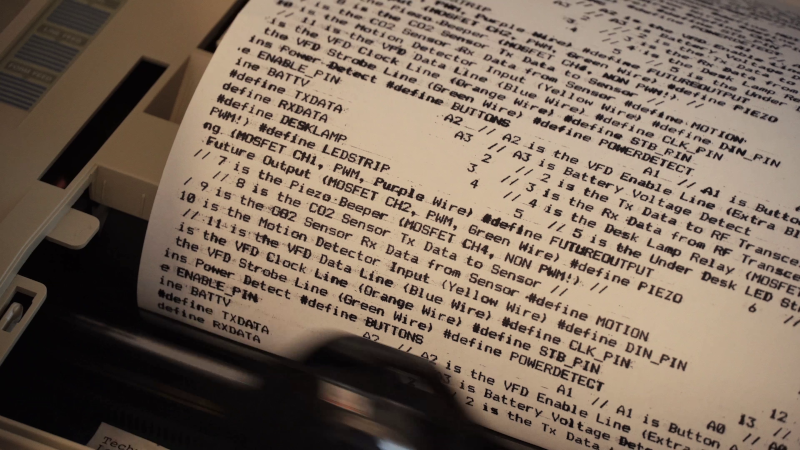
We were initially reserved about our success, suspecting that it wouldn’t hold up over time. We were pleasantly proven wrong, however. Four months on, the GX-80 continues to print beautifully. The replacement ribbon eventually shipped, yet remains in its packaging, still waiting for its time to shine. Further experiments on other printers have proven fruitful, too. Our Commodore MPS-1230 is now churning out pages with the best of them, after some initially blurry results when we got a little too excited with the WD40.
Overall, we learned a few valuable lessons. It’s possible, and preferable, to reink without disassembly. Most ribbons have a manual winder that allow the full length to be replenished easily. It’s also key to avoid over-diluting the ink, and washing out the ribbon. We’ve also been tempted to experiment with using actual bottled ink, rather than harvesting the guts of poor defenceless stationary — but that’s an experiment for another day.
Hopefully this guide helps other enthusiasts to get their dot matrixes up and running again, screaming away as they hammer out the pages. Until next time, happy printing!