Super glue, or cyanoacrylate as it is formally known, is one heck of a useful adhesive. Developed in the 20th century as a result of a program to create plastic gun sights, it is loved for its ability to bond all manner of materials quickly and effectively. Wood, metal, a wide variety of plastics — super glue will stick ’em all together in a flash.
It’s also particularly good at sticking to human skin, and therein lies a problem. It’s bad enough when it gets on your fingers. What happens when you get super glue in your eyes?
Today, we’ll answer that. First, with the story of how I caught an eyeful of glue. Following that, I’ll share some general tips for when you find yourself in a sticky situation.
How I Learned To Stop Worrying And Love The Glue
It was a beautiful summer’s evening in the suburbs, and I had been called upon to help a friend repair their car. The bulb holder in the tail light had broken, rendering it legally undrivable. It was all set to be an easy fix, just slot the plastic pieces gently back together before applying some glue to hold it all together, perhaps with some reinforcement to add some strength.
Unfortunately, I’d only brought hand tools, not realizing the job would call for adhesives. The glue available on site was super glue, but not my favored brand. It was a Loctite gel concoction — thick and gooey. In this form, the glue is easy to apply precisely and accurately, but it doesn’t readily penetrate cracks.
I’ve always been one to use the cheap and nasty stuff. It comes in packs of 8 for a dollar and it’s incredibly runny. It’s the perfect glue for when you need it to seep into the cracks of a broken plastic part and knit everything back together. I decided to go home and fetch a tube, as I couldn’t get the gel to do what I wanted.
Immediately, there was success. I’d managed to glue the bulb holder back together, and also glue the tube to my fingers. This was very much standard operating procedure, so I wasn’t particularly worried. I began to peel my fingers from the tube. Unfortunately, as my digits pulled free of the tube, the nozzle flicked a fat droplet of glue directly towards my face, landing in the corner of my eye.
I considered this a rather negative development. Luckily, I was able to keep my eye from blinking shut, and quickly held it open with my fingers. I also exclaimed rather loudly, in a less than joyous fashion. My friends rushed to my aid, and were able to lead me inside while I tried to avoid moving my eye as much as possible.
One of my friends was a contact lens user. This meant a saline eye rinse was available, and I flushed my eye repeatedly without blinking. After I was certain the glue was gone from the delicate white of my eyes, I very gingerly blinked. I was overjoyed when my eye reopened without sticking itself shut, and let out a deep sigh of relief.
I then proceeded to gently wipe away hardened glue from my lower eyelid and eyelashes. I was certain I had narrowly avoided disaster. Once all was calm, I decided to commence my research into just how bad that could have been.
The Facts
I was certain that I had narrowly avoided losing all vision in one eye. My research quickly proved that was not the
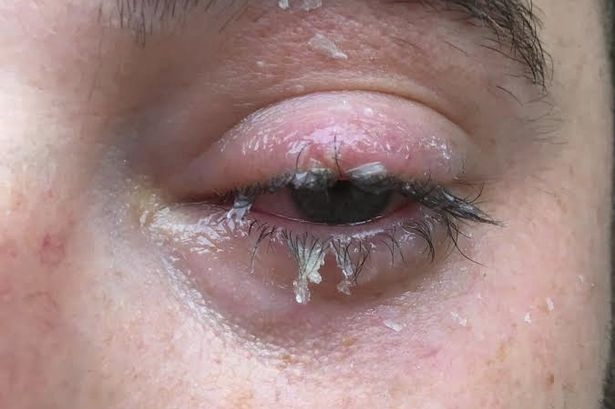
case. A literature study by Dr. Sagili Chandrasekhara Reddy covered 53 cases of super glue instillation in the eye over a period of 30 years. No cases of serious ocular damage were reported. In most occurances, medical professionals removed glue from the eye with forceps, trimmed stuck eyelashes, and irrigated the eye. Notably, no cases of serious ocular morbidity were reported. In layman’s terms, that means everyone went home with a pair of working eyeballs.
Surprisingly, this holds true for cases where significant amounts of glue have been squirted directly into the eyes. This happens more often than you might expect — tubes of super glue are often confused with eye drops, and it’s a common way for children to present to the ER. Even if you squirt the glue right in your eyes, you’re still unlikely to do any permanent damage.
Brown Emergency Medicine also note a lack of reports of serious eye damage due to super glue. Their advice states that if super glue is bonded to the eyeball or eyelids, that the eye can simply be irrigated with warm water, patched, and left alone. The glue should dissociate from the eye proteins and skin over a period of 1-4 days, and the eye will once again open.
What To Do When The Glue Strikes
If you are unlucky enough to get glue in your eyes, it can be quite a stressful experience. While such an incident is quite confronting, staying calm and not doing anything reckless is the key to protecting your vision. The following does not serve as medical advice, but as a general guide as to how to handle an ocular adhesive incident.
Your first step should be to avoid blinking if possible. This will only serve to increase the likelihood of gluing your eyes shut as the eyelids come together. Super glue sets in the presence of moisture, so this can also make it more likely the eyelids become stuck to the eyeball as well.
Following this, it’s important not to panic. Rash measures are far more likely to cause permanent eye damage than the super glue itself. Avoid trying to wipe the glue out, or putting any solid objects near the eye.
Thirdly, if safe, it can be helpful to flush the eye. This can be done with clean water or an appropriate medical solution, such as saline used by contact lens users. Whatever you use should be eye safe. Using anything to dissolve the glue is an absolute no-no (chemicals like acetone or nail polish removers will cause untold damage). If you’re at all unsure, skip this step entirely.
The final step is to seek professional medical attention. Doctors, nurses and surgeons have the proper training to deal with such injuries, along with the equipment required to treat them safely. Additionally, while super glue may not do any serious damage, it is possible to cause corneal abrasions or damage to the conjunctiva. Left untreated, this can lead to poor vision or infection. Eye drops or patching may be required in these cases, along with a consult with an ophthalmologist. If you’re out in the woods and help is days away, you might try rinsing your eyes and patching them for a few days, and they should reopen, but it’s always best to seek professional treatment wherever possible.
Play it Safe
In summary, super glue is a wonderful tool that need not be feared. However, to avoid a long night in the ER and embarassing yourself in front of your workmates, be careful out there. Think about what you’re doing and keep your eyes in mind as you work.
Hopefully you’ve found this guide useful, and you can have many further years of eye-safe adventures with cyanoacrylate!